Synchiropus sycorax, also known as the Ruby red dragonet, is a small, brightly colored fish with a distinct appearance. It features a bright red body and head, yellow belly and pelvic fins, and is adorned with white spots. The first dorsal fin of mature males is large and sail-like. These fish are known for their vibrant colors, unique behavior, and reef-safe nature.
Detailed Description:
Coloration: The head and body are bright red with prominent white spots. The belly and pelvic fins are yellow, and the pelvic-pectoral membrane of males may have a bluish or greenish-grey to black band.
Body Shape: It has a large head, top-mounted eyes, and a small, pointed mouth.
Fin Structure: The first dorsal fin of mature males is large and sail-like. The dorsal fin has well-defined stripes and short filaments.
Spot Pattern: The body has three rows of white spots: one along the lateral line, another above the anal fin, and a middle row extending from above the pectoral fin.
Size: Synchiropus sycorax is a relatively small fish.
Additional Information:
Synchiropus sycorax is a popular aquarium fish due to its vibrant colors, interesting behavior, and reef-safe nature.
They are known to be slow-moving, deliberate feeders and should not have to compete for food.
Their diet includes bloodworms, glassworms, and small invertebrates.
The royal gramma (Gramma loreto), also known as the fairy basslet, is a species of fish in the family Grammatidae native to reef environments of the tropical western Atlantic Ocean. They are commonly kept in aquariums.
Appearance
The fish can be a light purple to a deep violet starting at the head which fades mid-body to a golden yellow at the tail. The royal gramma will also have a small black spot on the front of the dorsal fin and a black line that streaks through the eye. It resembles the false gramma (Pictichromis paccagnellae), with the two main differences between the two being the false gramma has clear fins and does not fade, but rather has a distinct change in color. The royal gramma is relatively small, averaging slightly over 8 cm (3.1 in) and has been tank bred. The largest scientifically-measured royal gramma was 8 cm (3.1 in) long.
Diet
The royal gramma is a planktivore, eating mostly zooplankton and crustaceans. The royal gramma is also a cleaner fish. It removes the ectoparasites (a parasite that lives on the skin of a fish) from other fish and learns to eat dead food, such as crustaceans and fish flesh. They prefer to pick their food from the middle of the water coTheir natural range covers the Bahamas, Venezuela, Antilles, Bermuda, and through the waters surrounding Central America and the northern part of South America. The Royal Gramma tends to swim more towards the bottom with the depth range between 1 and 20 m (3 and 60 ft).
In the aquarium
Due to their relatively peaceful nature, diet, and small size, the royal gramma is considered an ideal inhabitant for most reef aquaria containing coral and other invertebrates. Notwithstanding this general statement, they can become aggressive towards tank-mates when kept in smaller nano reef tanks. They stake out territories throughout rocks and crevices and choose favorite hiding places. They are generally peaceful fish, but are very protective of their territories and are known for chasing out other small fish. They tend to stay in one area of the tank and, when startled, will dart back into their holes. They will vigorously guard their hiding places and, when threatened, will open their mouths wide in a threatening gesture to ward off the intruders. The royal gramma tends to orient itself to be parallel with the surface to which it is closest, resulting in the fish swimming straight up and down or sometimes upside down beneath ledges. This behavior is not to be mistaken for illness.
The minimum suggested tank size is 30 gallons and the tank should not receive sharp lighting. The ideal water temperature should range between 72 and 78 °F and the water pH should be between 8.1 and 8.4, with specific gravity of 1.020–1.025. They are often kept in reef aquaria and are generally kept singly or in pairs. However, small groups can be kept as long as the tank is large enough and has enough cracks and crevices for each fish to have its own territory. The royal gramma should not be kept with its own kind unless in a formed male-female pair. It should also not be kept with larger, aggressive fish that will eat them. They are, however, resistant to most diseases and make very good beginner fish. It will also accept frozen and meaty foods, such as brine shrimp and mysis shrimp in the wild. The royal gramma is very easy to feed, but rotating their foods is said to keep them from becoming picky. Captive royal gramma will also eat flake and pellet foods.
Breeding
Although pairs are difficult to find because the difference between male and female is not visible, they are very easy to breed. With males usually being larger than females, the male will build the nest among rocks using pieces of algae.The male will then lead the female to the nest, where she will deposit 20–100 eggs in the nest. The male exhibits the following nest care practices: protecting the nest and eggs, ongoing maintenance, frequent debris removal, and constant barging into the nest.During the breeding period, this behavior is repeated almost every day for a month or longer. The eggs are about 1 mm (0.04 in) and are equipped with small protuberances over the surface with tiny threads extending from them. These threads hold onto the algae of the nest and keep the eggs in place. The eggs will hatch in five to seven days, normally in the evening, and can feed on rotifers until they are large enough to consume newly hatched brine shrimp
Naso vlamingii, the bignose unicornfish, scibbled unicornfish, Vlaming's unicornfish, and zebra unicornfish, is a species of marine ray-finned fish belonging to the family Acanthuridae, the surgeonfishes, unicornfishes and tangs. This species is found in the Indo-Pacific.
Taxonomy
Naso vlamingii was first formally described as Naseus vlamingii in 1835 by the French zoologist Achille Valenciennes with its type locality given as Molucca Island in Indonesia.[3] This species is classified within the nominate subgenus of the genus Naso.[4] The genus Naso is the only genus in the subfamily Nasinae in the family Acanthuridae.
Etymology
Naso vlamingii has the specific name which honours the Dutch explorer Admiral Cornelis de Vlamingh who collected specimens and drew illustrations of fishes for the Muséum national d’Histoire naturelle and Valenciennes based his description on one of Vlamingh's illustrations.[4]
Description
Naso vlamingii has 6 spines and 26 or 27 soft rays all of similar height supporting the tall dorsal fin and 2 spines and between 27 and 29 soft rays supporting the anal fin. It has a relatively deep body with standard lengths ranging from 2.2, in subadults, to 2.6, in adults, times the body's depth. There is an obvious bulbous protuberance growing from the head above the snout. There are two bony plates on each side of the caudal peduncle and these have keels with anterior pointing spines. The adults develop long filaments from the tips of the caudal fin lobes. The overall colour of the adults is greyish-brown or reddish brown, and they have the ability to change colour quickly, with small dark blue spots on the head and upper flanks. These spots join up to form stripes on the lower flanks. There is a wide blue band running from the eye to the front of the bulbous protuberance. The lips are blue and there is an irregular blue blotch to the rear of the base of the pectoral fin. The caudal fin is blue at its base, grey in the middle with an ill-defined yellow marginand blue outer edges of the lobes and this extends onto the filaments. The intensity of the colour of the blue markings can be increased to a brilliant blue when the fish is displaying in courtship or to communicate with cleaner fish at cleaning stations.This species has a maximum published length of 60 cm (24 in).
Distribution and habitat
Naso vlamingii has a wide Indo-Pacific range which extends from the eastern coast of Africa between Kenya and South Africa, through the Indian Ocean islands, but it is absent the continental southern Asian waters, through the Andaman Sea, Indonesia and into the Pacific. In the Pacific it extends north to southern Japan, east to the Galápagos Islands and south to New Caledonia and Australia.[1] In Australia the species is found at a number of offshore islands and reefs, as well as from the northern Great Barrier Reef south to waters off Sydney in New South Wales and in the waters around Lord Howe Island in the Tasman Sea. The bignose unicornfish is found in deep lagoons and seaward reefs, frequently aggregating in schools that feed on zooplankton around the higher areas of deep slopes and drop-offs.
Biology
Naso vlamingii can live up to 40 years in captivity.[8] Their eggs are fertilized externally after being released in batches by the female. Spawning typically occurs in aggregations, where many individuals come together to release their eggs and sperm simultaneously. They change their feeding pattern throughout their lives. Juveniles are herbivores; feeding mainly with algae, semi-adults are omnivores and adults are primarily carnivores; hunting for zooplankton.
Centropyge bispinosa, commonly known as the Coral Beauty Angelfish or Dusky Angelfish, is a small, colorful angelfish with a distinctive appearance. They have a bright orange body with vertical blue or purple "tiger" stripes, and a blue-purple head, dorsal, caudal, and anal fins. Their pectoral and pelvic fins are typically yellow or orange.
Key Characteristics:
Color: Orange body with blue/purple stripes, blue/purple head and fins.
Size: Reaches up to 4-5 inches (10-12 cm) in length.
Behavior: Peaceful, but can be territorial with their own kind and other dwarf angelfishes.
Habitat: Found on outer reef slopes and in rocky areas with hiding spots.
Diet: Primarily eats algae and detritus.
Reproduction: Protogynous hermaphrodites, meaning they can change sex.
Reef Compatibility: Considered reef-safe, but individuals may nip at certain corals, especially soft corals.
Distribution:
Found in the Indo-Pacific region, including Australia, Japan, the Philippines, and other tropical waters
Most commonly found is pure blue, dark blue, or light blue, although observers find the aqua, purple, or orange variation throughout the ocean. These sea stars may grow up to 30 cm (11.8 in) in diameter, with rounded tips at each of the arms; some individuals may bear lighter or darker spots along each of their arms. Individual specimens are typically firm in texture, possessing the slightly tubular, elongated arms common to most of other members of the family Ophidiasteridae, and usually possessing short, yellowish tube feet. An inhabitant of coral reefs and sea grass beds, this species is relatively common and is typically found in sparse density throughout its range. Blue stars live subtidally, or sometimes intertidally, on fine (sand) or hard substrata and move relatively slowly (mean locomotion rate of 8.1 cm/min).
The genus Linckia, as is true of other species of starfish, is recognized by scientists as being possessed of remarkable regenerative capabilities, and endowed with powers of defensive autotomy against predators.Although not yet documented, L. laevigata may be able to reproduce asexually. L. laevigata is apparently not an exception to this behavior, as many individuals observed in nature are missing arms or, on occasion, in the comet form.
This sea star is fairly popular with marine aquarium hobbyists, where it requires a proper, slow acclimatization before entering the tank system, and an adequate food source similar to that found in its natural habitat. Generally thought of as a detritivore, many sources maintain that this species will indefinitely graze throughout the aquarium for organic films or sedentary, low-growing organisms such as sponges and algae. In the marine aquarium hobby, they have been seen to consume Asterina Starfish, which are commonly introduced into such aquaria on the ubiquitous "live rock" used in such settings.
Sabellastarte spectabilis, commonly known as the Indian feather duster worm or feather duster worm, is a tubicolous marine polychaete worm. These worms are characterized by their beautiful, feathery tentacles, which they use to filter feed and breathe. They live in leathery tubes, often covered with mud, and are found in tropical and subtropical waters.
Appearance:
Color: Vibrant colors can range from reds, oranges, to purples.
Tentacles (radioles): The tentacles are feathery and arranged in a fan-like structure, creating a striking display when the worm is active. They are striped in dark and pale brown bands.
Tube: The worms secrete a leathery tube that protects them.
Size: Can reach up to 80 millimeters in length and 10-12 millimeters in width.
Habitat and Behavior:
Location: Native to tropical waters of the Indo-Pacific but have spread to other regions.
Tube: The tubes are typically buried in the sediment.
Filter Feeding: They use their tentacles to capture small particles of organic matter from the water.
Sedentary Lifestyle: They primarily live within their tubes and do not move much.
Reproduction and Other Characteristics:
Asexual Reproduction: They can reproduce asexually by fragmentation.
Regeneration: They can regenerate body parts if damaged.
Aquarium Popularity: They are popular in aquariums due to their beauty and helpfulness in removing organic particles from the water.
Nardoa novaecaledoniae, also known as the Goldtip Starfish, Yellow Mesh Sea Star, or Peach Tip Mesh Sea Star, is a species of sea star in the family Ophidiasteridae. These starfish are found in the Indo-Pacific region, including areas like Australia, Indonesia, and the Philippines.
Key features of Nardoa novaecaledoniae:
Appearance: They are characterized by their vibrant coloration, often with a tan to brown body and golden or peach-colored tips on their arms. The arms can also have white spots on the central disc that get smaller as they move towards the arm tips.
Size: Nardoa novaecaledoniae can grow up to 10 inches (25 cm) in diameter.
Habitat: They typically inhabit shallow, rocky reefs.
Diet: They are omnivores, feeding on algae, small fish, and mussel flesh.
Care: They are not commonly seen in the home aquarium trade and can be sensitive to sudden changes in salinity.
Range: They are found in the Western Pacific Ocean.
The Ciliopagurus strigatus, commonly known as the Halloween hermit crab, is a brightly colored hermit crab with a vibrant orange and black striped appearance. They are popular in marine aquariums due to their distinctive colors and usefulness as algae eaters and scavengers.
Key features and characteristics:
Appearance:
The Halloween hermit crab is easily recognizable by its bright orange and red striped "stockings". They also have a small claw on the left side.
Habitat:
They are found in the Central Pacific region, and are often associated with reef environments.
Diet:
They are omnivores, feeding on algae, detritus, leftover food, and sometimes other small creatures.
Behavior:
They are scavengers, sifting through the substrate to clean up detritus and algae. They also help aerate the substrate by moving the sand.
Reef-safe:
Generally considered reef-safe, they do not pose a threat to reef corals or other reef inhabitants.
Shells:
They live in borrowed shells, usually abandoned snail shells, and may even attack and consume snails to obtain a shell.
Maintenance:
In aquariums, they should be provided with a variety of shells to choose from, and their diet may need to be supplemented with algae and other food items if necessary.
In short, the Halloween hermit crab is a visually appealing and useful addition to a marine aquarium, known for its vibrant colors, algae-eating habits, and cleaning skills
Bubble-tip anemones, scientifically named Entacmaea quadricolor, are sea anemones known for their distinctive, bulbous tentacle tips. These anemones display a range of colors, including greens, tans, browns, and maroons. They have a sticky foot called a "basal disc" that they use to attach to surfaces, and their bodies consist of a cylindrical stalk topped with an oral disc surrounded by tentacles.
Key features of Bubble-tip Anemones:
Bulbous Tentacles:
The most prominent feature is the bubble-like or pear-shaped tips on their tentacles, which give them their common name.
Color Variation:
They can be found in various colors, including green, tan, brown, and maroon.
Sticky Foot:
They have a basal disc (or pedal disk) that helps them anchor to surfaces.
Symbiotic Relationship:
Bubble-tip anemones can host clownfish and other anemonefish, forming a beneficial symbiotic relationship.
Growth:
They can grow up to a foot in diameter, but typically remain smaller in aquariums.
Location:
They are found in oceans around the world, including the Indo-Pacific area and the Red Sea.
In essence, the Bubble-tip Anemone is a vibrant, adaptable creature with unique characteristics, making it a popular choice for marine aquariums
price per polyp
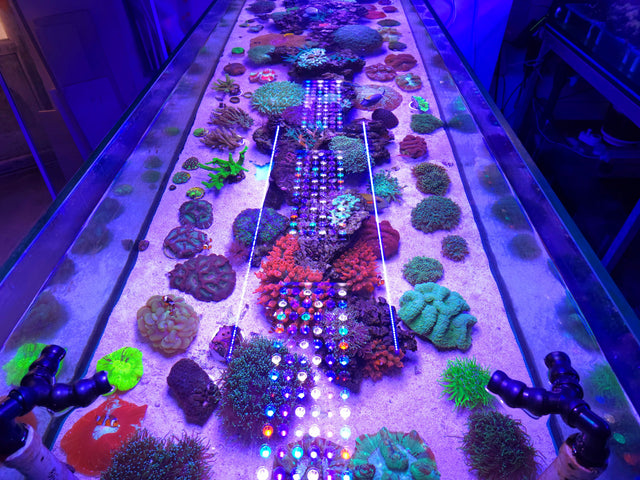
Rhodactis, commonly known as mushroom corals, are a type of corallimorph that are easily recognizable by their large, individual polyps that resemble mushrooms. They are related to stony corals but do not form a stony skeleton. Rhodactis are popular in reef aquariums for their easy care and adaptable nature.
Key Characteristics of Rhodactis:
Appearance:
They are soft, fleshy, and have a jelly-like texture. Their individual polyps can be quite large, often reaching 1-18 inches in size.
Color and Texture:
They come in a wide variety of colors, including green, brown, tan, pink, and purple, and can have different textures, some even resembling hairy mushrooms.
Habitat:
They are found in the Indo-Pacific region, including Fiji, Tonga, Solomon Islands, and the Great Barrier Reef.
Care:
Rhodactis are known for being easy to care for and can thrive in a variety of aquarium environments.
Feeding:
They are photosynthetic and can also feed on particulate matter and small invertebrates.
Lighting:
Rhodactis generally prefer low to moderate lighting, ideally in the range of 75-150 PAR.
Flow:
They prefer low to moderate water flow.
Rhodactis in Reef Aquariums:
Rhodactis mushrooms are a popular choice for both beginner and experienced aquarists.
They can be placed in a variety of reef tank environments, making them a versatile choice.
They can be propagated (fragged) by experienced hobbyists.
Some species, like the Elephant Ear variety, can even be aggressive feeders and may consume smaller fish.
Gorgonia, or sea fans, are a genus of soft corals found in marine environments, particularly in areas with strong water currents. They are characterized by their fan-like shape and often have a purple hue, though other colors like brown or yellow can also occur. Sea fans are colonial invertebrates, meaning they are made up of many individual polyps, which are small, fragile, white "flower-like" structures.
Key Features:
Colonial Nature:
Gorgonians are colonies of polyps, which are attached to a central axis composed of gorgonin and calcite.
Fan-like Structure:
The polyps are arranged in a fan-like pattern, creating the distinctive shape of sea fans.
Color Variation:
While often purple, sea fans can also be brown, yellow, or even pink, depending on environmental factors and the presence of pigments in their spicules (needle-like parts of calcium carbonate).
Filter Feeders:
Sea fans are filter feeders, meaning they capture small particles of food from the water current using their tentacles.
Geographic Distribution:
Common sea fans (Gorgonia ventalina) are found in the Caribbean Sea and tropical western Atlantic, including areas like the Florida Keys, Cuba, Belize, and Venezuela
Briareum is a genus of soft corals in the family Briareidae.The coral is cultivated by aquarium owners (under the common name "green star polyp" or GSP) for its fluorescing polyps, which reveal themselves under actinic light. The genus is in need of extensive examination, as many specimens sold by marketers display unique and similar characteristics, but are often labeled as one species, Pachyclavularia violacea.