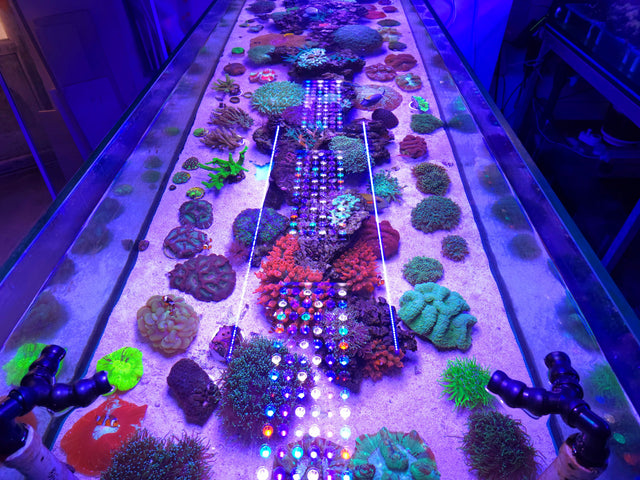
Ricordea yuma is a vibrant, soft coral species known for its distinctive, often bright colors and irregular, bubble-like tentacles. They are a popular choice for reef aquariums due to their relatively easy care and beautiful appearance. Ricordea yuma are native to the Pacific Ocean and are known for their ability to thrive in a variety of lighting conditions. They can reproduce both sexually and asexually through budding.
Key Characteristics:
Shape: Ricordea yuma typically have a rounded or lobed shape, with a large mouth disk.
Color: They come in a wide range of colors, including neon greens, oranges, and blues.
Tentacles: Their surface is covered with an irregular mat of short, bubble-like tentacles.
Care: They generally prefer moderate to high lighting and moderate water flow.
Growth: They can spread by budding, allowing them to colonize areas quickly.
Hardiness: They are relatively hardy and suitable for both beginner and experienced reef keepers.
Distinguishing Features from Ricordea Florida:
Ricordea yuma tend to have a higher concentration of tentacles around the mouth, while Ricordea florida have a more random distribution of tentacles.
Ricordea yuma also tend to have alternating rows of large and small tentacles radiating outwards from the mouth.
The yellow prawn-goby, or Cryptocentrus cinctus, is a small, bottom-dwelling goby native to the Western Pacific. They are known for their symbiotic relationship with alpheid shrimps, sharing burrows and benefiting each other. The fish can range in color from bright yellow to gray or brown, and can grow up to 10 centimeters long.
Here's a more detailed look at the yellow prawn-goby:
Appearance:
They can have a brilliant yellow color.
They can also have gray or brown coloration.
They may have a combination of these colors.
They often have 4-5 dusky bars and fine blue or white spotting on their head and body.
They can reach a length of up to 10 cm (3.9 in).
Habitat and Behavior:
They are found in coastal bays and lagoons.
They inhabit depths of 1 to 25 meters (3.3 to 82.0 ft).
They are symbiotic with alpheid shrimps.
They share burrows with shrimps, with the shrimp digging and maintaining the tunnel while the goby acts as a watchman.
Other Notable Features:
They can change color based on their environment and comfort level.
In good conditions, they are a bright yellow.
Under stress, they can become gray or brown.
They are popular in saltwater aquariums.
They are often kept in aquariums as small as 20 gallons (75 L).
The Dispar Anthias, Pseudanthias dispar, is a small, colorful reef fish known for its vibrant colors and peaceful temperament. It's a popular choice for home aquariums, particularly for those with reef tanks.
Key Features:
Coloration: Males have a bright red dorsal fin and a distinctive purple-edged orange stripe. Females display a yellowish-orange top and pale lavender to white underside.
Size: They grow to a maximum of 10 cm (4 inches).
Temperament: They are generally peaceful and reef-safe, making them suitable for community tanks.
Habitat: They are found in shallow waters on coral reefs and outer reef slopes.
Aquarium Care:
Water Parameters: They prefer a temperature of 23-28°C, a pH between 8 and 8.5, and good water quality with low nitrates.
Tank Size: A minimum of 200 liters (50 gallons) is recommended for a small group.
Social Structure: They are social and thrive in groups of one male and 3-4 females.
Diet: They are active planktivores and prefer a diet of frozen mysis shrimp, enriched brine shrimp, and high-quality flake food.
Reef Compatibility: They are reef-safe and can be kept with other peaceful reef inhabitants.
Distinctive Features:
Hermaphroditic: Anthias are known for being hermaphroditic, meaning they can change sex if a dominant male dies.
Schooling Behavior: They naturally live in schools, so keeping them in groups is recommended.
Pseudanthias squamipinnis, commonly known as the Sea Goldie or Lyretail Anthias, is a vibrant, colorful fish with a distinctive appearance. Males are purplish-pink with a pink to orange stripe and a red patch on their pectoral fins, while females are golden-orange with a violet streak. They have elongated dorsal and caudal fins, particularly in males.
Here's a more detailed description:
Males: Purplish-pink with a pink to orange stripe from the eye to the pectoral fin base. They also have a red patch on the pectoral fin, pale spots on a blue anal fin, and elongated dorsal and caudal fins.
Females: Golden-orange with a violet streak below the eye.
Body Shape: Oval, laterally flattened body.
Scales: Scales may have a red edge.
Fins: Usually reddish or pink, occasionally with blue or purple edges.
Size: Can reach a maximum total length of about 15 centimeters.
Other Notable Features: Some populations exhibit variations in coloration, but generally feature gold and red tones with an orange/blue cheek stripe.
Behavior: Known for their attractive colors and are often shy, hiding under overhangs during the day.
Protogynous Hermaphrodite: A male can retain a harem of females, and the largest and most dominant female can transition to a male role when necessary.
A pair of Synchiropus splendidus, also known as the Splendid Mandarin, are characterized by their vibrant, multicolored appearance and unique body shape. They are small, scaleless fish with a broad head and elongated body, reaching about 3 inches in length. Their bodies are primarily blue, adorned with intricate patterns of orange, red, and yellow lines. Males have a more pointed, elongated first dorsal fin compared to females.
Key features of a pair of Synchiropus splendidus:
Coloration: Vivid blue, orange, red, and yellow patterns create a striking visual display.
Body Shape: Broad head and elongated body, with no scales.
Sexual Dimorphism: Males have a more elongated and pointed first dorsal fin.
Fin Structure: They possess two short dorsal fins, two large pectoral fins, and a large anal fin.
Habitat: Primarily bottom-dwelling reef fish, found in sheltered lagoons and inshore reefs.
Behavior: Slow-moving, peaceful, and slightly territorial, they typically live in pairs or small groups.
Diet: Primarily carnivores, feeding on small crustaceans and invertebrates.
The Spotted Mandarin Dragonet, Synchiropus picturatus, is a popular aquarium fish known for its vibrant colors and peaceful nature. It's best kept as a pair, with a single male and female, though they can also live alone or in small, loose groups. They are often solitary, spending much of their time near the substrate or rocks in their natural habitat.
Key aspects of keeping a Synchiropus picturatus pair:
Pairing: A male and female pair is ideal, as they can live peacefully together.
Size: They can grow up to 8cm in length.
Tank Size: A minimum of 100 liters is recommended for a single specimen, with larger tanks needed for pairs or groups.
Diet: They are carnivorous and primarily feed on live microfauna like amphipods and copepods, which need to be present in sufficient numbers in the tank.
Tank Mates: Peaceful fish, seahorses, pipefish, and other small fish are good tank mates. They are not compatible with highly aggressive or competitive fish.
Aquarium Setup: They require a well-established aquarium with plenty of live rock for grazing and hiding, and a sandy bottom.
Temperament: They are generally peaceful and do not harm corals or invertebrates.
The picturesque dragonet (Synchiropus picturatus) is a brightly colored member of the dragonet family native to the Indo-West Pacific: Philippines, eastern Indonesia and northwest Australia. It occasionally makes its way into the aquarium trade, where it is commonly known as the spotted mandarin, psychedelic mandarin or target mandarin.
Description
The picturesque dragonet may grow to a size of 7 cm in length. They have thick slime on their skin that inhibits many types of parasitic infection and minimizes the risk of disease following stress or physical trauma. This seems to help protect them from some other more aggressive fish.
Synchiropus picturatus is one of only two vertebrates known to have blue colouring because of cellular pigment, the other being the closely related Synchiropus splendidus. The name "cyanophore" was proposed for the blue chromatophores, or pigment-containing and light-reflecting cells. In all other known cases, the colour blue comes from thin-film interference from piles of flat, thin and reflecting purine crystals.
This species is quite harmless to humans and is quite peaceful with other species. The Picturesque dragonet is a marine animal that naturally lives at a temperature between 24-28 C.
The red-eye wrasse (Cirrhilabrus solorensis) is a species of wrasse native to Indonesia and Australia, where found near the Lesser Sundas, Maluka and Darwin. It inhabits coral reefs on coastal and outer reef lagoons at depths of 5 to 35 m (16 to 115 ft).
Adult male C. solorensis have a yellowish-dusky or yellow-green snout to crown, blue operculum, purple neck-region, yellow-orange upper body and blue belly. It can reach a total length of 11 cm (4.3 in).Until 2021, it was commonly confused with C. aquamarinus and C. chaliasi, which occur in similar habitats and all have mostly reddish eyes. In C. aquamarinus, which is found near Sulawesi, the adult male has a mostly deep yellow head, a dark blue back and operculum, and much of the body is blue-green. In C. chaliasi, which is found near the Lesser Sundas and Tukangbesi Islands, the adult male has a pinkish-red head, yellow-orange upper body and blue belly.Females of these species are considerably duller and not as easily separated.
C. solorensis occurs in small harems of one male, several females and juveniles. It is regarded as data deficient by the IUCN. It can be found in the aquarium trade.
The foxface rabbitfish (Siganus vulpinus), also known as the foxface, black-face rabbit fish, badger fish or the common foxface is a species of marine ray-finned fish, a rabbitfish belonging to the family Siganidae. It is found in the Indian and Pacific Oceans. It can be found in the aquarium trade.
Taxonomy
The foxface rabbitfish was first formally described as Amphacanthus vulpinus in 1845 by the German zoologists Hermann Schlegel & Salomon Müller with the type locality given as Ternate Island one of the Molucca Islands in Indonesia.The blotched foxface (S. unimaculatus) differs from S. vulpinus in possessing a large black spot below the soft-rayed part of the dorsal fin. It is sympatric and not phylogenetically distinct, and though these two might be recently evolved species, they may be just colour morphs and should arguably to be united under the scientific name S. vulpinus. under the scientific name S. vulpinus.The specific name vulpinus means "fox-like", Schlegel and Müller did not explain what this alluded to but it is thought to be the pointed snout.
Description
The foxface rabbitfish has a compressed body which has a depth which fits into its standard length 1.9 to 2.4 times. The dorsal profile of the head is steep to the rear of the eye and there is an indentation between the eyes and a tubular snout. The caudal fin is weakly forked. There is a procumbent spine in the nape to the front of the dorsal fin.Like all rabbitfishes, the dorsal fin has 13 spines and 10 soft rays while the anal fin has 7 spines and 9 soft rays. The fin spines hold venom glands. This species attains a maximum total length of 25 cm (9.8 in), although 20 cm (7.9 in) is more typical.The main colour on this rabbitfish is vivid yellow with white on the head and front part of the body, however foxfaces can camouflage when experiencing threat, quickly changing colour to a dark brown. There is a black band running backwards from the mouth through the eye to the start of the dorsal fin and there is a black area on the breast that runs upwards to just above the base of the pectoral-fin, tapering as it does so.
Distribution and habitat
The foxface rabbitfish occurs in the far eastern Indian Ocean and in the western Pacific from Indonesia to the Marshall and Gilbert Islands north as far as Taiwan and south to New Caledonia and Australia.[1] In Australia it is found from Western Australia on the northern reefs and offshore reefs, at Ashmore Reef in the Timor Sea, and on the east coast in Queensland from the northern Great Barrier Reef to the Capricorn Islands. It has been recorded as deep as 30 m (98 ft).[1] This species lives in lagoons and seaward reefs where there is a rich growth of corals.
Biology
The foxface rabbitfish is omnivorous, eating mostly algae and zooplankton. They may be territorial, adults are normally found as either solitary individuals or in pairs and are associated with branching Acropora corals. Juveniles and subadults may sometimes form large schools, feeding on algae growing on the bases of Acropora corals.This species produces venom in the spines of its fins.In a study of the venom of a congener it was found that rabbitfish venom was similar to the venom of stonefishes.
Utilisation
The foxface rabbitfish appears in the aquarium trade. No statistics are kept for the catch and in some areas this species appears in mixed catches of reef fish, caught by spearfishing.
Naso elegans, the elegant unicornfish, the blonde naso tang, Indian orange-spine unicorn, lipstick surgeonfish, lipstick tang, orangespine unicornfish or smoothheaded unicornfish, is a species of marine ray-finned fish belonging to the family Acanthuridae, the surgeonfishes, unicornfishes and tangs. This species is found in the Indian and western Pacific Oceans.
Taxonomy
Naso elegans was first formally described as Aspisurus elegans in 1829 by the German zoologist and explorer Eduard Rüppell with its type locality given as the northern Red Sea. This species is classified within the nominate subgenus of the genus Naso.[The genus Naso is the only genus in the subfamily Nasinae in the family Acanthuridae. For a long time this species was regarded as an Indian Ocean colour morph of the orangespine unicornfish (Naso lituratus) until it was shown that there were consistent meristic differences.
Etymology
The specific epithet elegans is Latin for "choice", "fine" or "select", a reference to the beautiful colours of this fish.
Distribution and habitat
Naso elegans is found in the Indian and Pacific Oceans. It occurs in the Red Sea south along the east African coast to Durban in South Africa and eastward across the Indian Ocean into the Pacific where it reaches as far east as Bali in Indonesia. It is absent from the waters off the mainland Indian subcontinent.[1] In Australian waters it has been recorded from Christmas Island and the Cocos (Keeling) Islands. The elegant unicornfish occurs in reef flats in coastal and inshore waters in small schools while in more oceanic waters it forms larger schools,
Description
Naso elegans has 6 spines and between 26 and 30 soft rays, typically 28, supporting the dorsal fin while the anal fin is supported by 2 spines and between 27 and 30 soft rays, typically 29. The pectoral fin contains 16, or more usually, 17 fin rays. There are between 30 and 35 teeth in each jaw and, in adults, these are similar to incisors and have rounded edges. The body has a depth which is equivalent to roughly a quarter of the standard length and it grows more elongate as the fish grows.The keels on the caudal peduncle are larger in males than in females and the males also have longer filaments growing from the caudal fin. The overall colour is grey, with a dark snout separated from the grey head by a yellow bar at the eyes. The dorsal fin is yellow with a thin blue edge and a black band inside that. The anal and pelvic fins are dark brown.The plates on the caudal peduncle are vivid orange separated by a patch of white.The caudal fin is yellowish with a black submarginal band and black lower and upper edges. The elegant unicornfish has a maximum total length of 45 cm (18 in), although 35 cm (14 in) is more typical.
Biology
Naso elegans is a herbivore, feeding on benthic algae,[8] particularly brown algae in the genera Sargassum and Dictyota.
Acanthurus triostegus, commonly known as convict tang, manini,convict surgeonfish, convict surgeon, or fiveband surgeonfish, is a species of marine ray-finned fish belonging to the family Acanthuridae which includes the surgeonfishes, unicornfishes and tangs. This species has a wide Indo-Pacific distribution.
Taxonomy
Acanthurus triostegus was first formally described in 1758 as Chaetodon triostegus by Carl Linnaeus, the description being published in the 10 edition of Systema Naturae with its type locality given as "Indies".The genus Acanthurus is one of two genera in the tribe Acanthurini which is one of three tribes in the subfamily Acanthurinae which is one of two subfamilies in the family Acanthuridae.
Etymology
Acanthurus triostegus was given the specific name triostegus which means "three covers", this may refer to the three branchiostegal membranes.
Description
The convict tang is so called because of its bold black stripes on a yellowish background. It is a laterally-compressed oval-shaped fishwith a maximum length of about 26–27 cm (10–11 in). The head is small with a pointed snout and a terminal mouth with thick lips. It has six black stripes which distinguishes it from the zebra tang (Acanthurus polyzona) which has nine, and has a more restricted range in the Indian Ocean. The first black stripe is oblique and passes through the eye. There are two black spots on the caudal peduncle, and on each side there is a sharp, retractable spine, which is used in offence or defence.
Distribution and habitat
Acanthurus triostegus occurs in the tropical Indo-Pacific region. Its range extends from the East African coast and Madagascar to southwestern Japan, Australia and Central America, including many Pacific island groups. It is found over hard bottoms in lagoons, reef slopes, bays and estuaries. Juveniles are common in tide pools, and larger fish are found at depths down to about 90 m (300 ft).
Biology
Acanthurus triostegus frequently feed in the vicinity of freshwater discharges, grazing filamentous algae off the rocks.Typically these tangs graze on filamentous algae growing on coral or rocky substrates. The adults aggregate in large schools to feed and these overwhelm damselfishes attempting to defend their territories. The males and females gather in aggegations to spawn.
Utilisation
Acanthurus triostegus is targeted as a food fish in many parts of its range and in some areas is commercially targeted. In Hawaii it is fished for by recreational anglers and it is also caught for the aquarium trade.
Ctenochaetus tominiensis, the Tomini surgeonfish, Tomini bristletooth, yellowtip bristletooth or orangetip bristletooth, is a species of marine ray-finned fish belonging to the family Acanthuridae which includes the surgeonfishes, unicornfishes and tangs. This fish is found in the western central Pacific Ocean.
Taxonomy
Ctenochaetus tominiensis was first formally described in 1955 by the American ichthyologist John Ernest Randall with its type locality given as Sadaa Island in the Gulf of Tomini, Sulawesi, Indonesia.The genera Ctenochaetus and Acanthurus make up the tribe Acanthurini which is one of three tribes in the subfamily Acanthurinae which is one of two subfamilies in the family Acanthuridae.
Description
Ctenochaetus tominiensis has its dorsal fin supported by 8 spines and 24 or 25 soft rays while the anal fin is supported by 3 spines and 22 or 23 soft rays. The rear ends of the dorsal and anal fins are, uniquely in the genus Ctenochaetus, angular. The lips have warty margins. In juveniles the caudal fin is forked and in adults it is lunate. The maximum published standard length of this fish is 16 cm (6.3 in).The overall colour of the body is yellowish brown with a white caudal fin and broad yellow margins to the dorsal and anal fins.
Distribution and habitat
Ctenochaetus tominiensis is found in the western central Pacific Ocean from Malaysia and Indonesia east through East Timor, the Philippines, Palau, Micronesia, Papua New Guinea, the Solomon Islands, Tuvalu, Vanuatu and Fiji, south to the Great Barrier Reef. It has been recorded from Tonga.This species is found solitarily or in small aggregations on steep drop offs with dense coral growth in inshorse, sheltered waters at depths between 0 and 45 m (0 and 148 ft).
Echinaster sepositus, the Mediterranean red sea star, is a species of starfish from the East Atlantic, including the Mediterranean Sea.
Description
Echinaster sepositus has five relatively slender arms around a small central disc. It usually has a diameter of up to 20 cm (8 in), but can exceptionally reach up to 30 cm (12 in).It is a bright orange-red in colour, and has a soapy surface texture unlike superficially similar Henricia starfish (another somewhat similar species from the same region is Ophidiaster ophidianus). The surface is dotted with evenly spaced pits from which the animal can extend its deep red gills (papula).
Distribution
Echinaster sepositus is found in the East Atlantic north of the Equator, including the Mediterranean Sea where it is one of the most common starfish (although virtually absent from some localities). Its northern limit is the English Channel, but only on the French side. It is found at depths of 1 to 250 m (3–820 ft) in a wide range of habitats, including rocky, sandy and muddy bottoms, and sea grass meadows (Posidonia oceanica and Zostera)