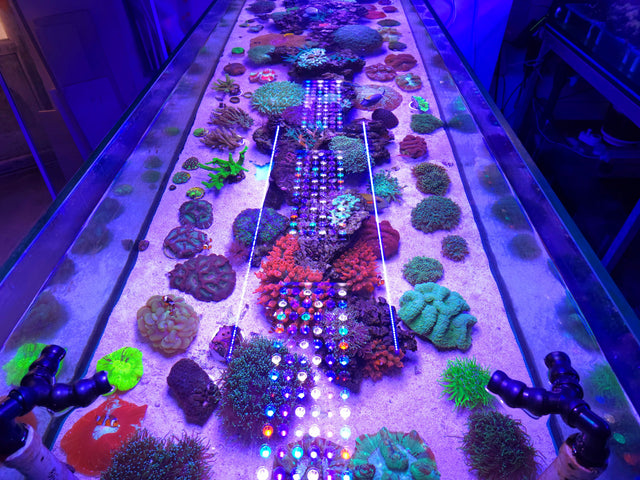
Trachyphyllia, commonly known as the open brain coral, is a free-living coral species in the Merulinidae family. They are large polyp stony corals (LPS) characterized by a flabello-meandroid growth form, meaning they have distinct valley regions separated by walls, resembling an inverted brain. These corals are often brightly colored and found in inter-reef environments and on soft substrates around continental islands.
Here's a more detailed breakdown:
Appearance and Features:
Shape: Trachyphyllia are free-living, meaning they can move around and are not anchored to rocks. They have a flabello-meandroid growth pattern, with distinct valleys separated by walls.
Size: They are relatively small corals, typically not exceeding 20 cm in diameter.
Color: Trachyphyllia come in a wide variety of colors, including yellow, brown, blue, green, and red.
Tentacles: They have short tentacles that are often extended during feeding.
Mouth: They have one to three separate mouths within their valleys.
Habitat and Distribution:
Location: Trachyphyllia are found in inter-reef environments and on soft substrates around continental islands.
Substrate: They prefer to rest on soft substrates like sandbeds.
Water Conditions: They thrive in moderate to strong lighting and moderate water currents.
Care and Maintenance:
Lighting:
They generally prefer moderate lighting (100-150 PAR), but can tolerate lower light conditions.
Water Flow:
They do not like strong currents and should have moderate, indirect water flow.
Feeding:
They are voracious feeders and can be supplemented with various foods like brine shrimp and mysis, according to Tidal Gardens.
Placement:
They should be placed on the sand or substrate bed, allowing for proper movement and feeding.
Aggression:
Trachyphyllia can be a bit aggressive and should be placed with ample space from other corals
Australomussa, scientifically named Parascolymia rowleyensis, is a type of large polyp stony coral (LPS) found in the Indo-Pacific region, particularly in Australia and Southeast Asia. These corals form flattened, dome-shaped colonies, with corallites characterized by shallow valleys and distinct color and texture differences between the septa and costae. They are known for their vibrant colors, which can range from blue-grey to bright reds, yellows, and greens.
Detailed Description:
Colony Structure:
Australomussa corals grow into large, dome-shaped or helmet-shaped colonies, sometimes reaching several meters in size.
Corallites:
The corallites, which are the individual polyps, are subcerioid, meaning they have short, shallow valleys that are separated by thick walls.
Tissue Color:
The tissue over the septa (the radial plates within the corallites) is often a different color and/or texture compared to the tissue over the costae (the outer walls of the corallites).
Habitat:
These corals are typically found in lower reef slopes, where they are protected from strong wave action.
Color:
In north-west Australia, colonies often exhibit a uniform blue-grey color, while valleys may have concentric cream and green hues. In Southeast Asia, a wider range of colors, including bright red, yellow, and green, are commonly observed.
Similar Species:
The corallite details of Parascolymia rowleyensis are similar to those of Parascolymia vitiensis, another large polyp stony coral.
Abundance:
While they can be locally common in certain areas, Australomussa corals are not typically abundant.
Stylophora pistillata, commonly called smooth cauliflower coral or hood coral, is a species of stony coral in the Indo-Pacific region. It has a branching growth form, with blunt-ended branches that thicken and become more massive as the colony matures. Corallites (the individual polyps' stony cups) are conical or hooded and partially submerged in the coenosteum (the stony framework of the colony). These corallites have a prominent, solid columella (the central column) and may have six primary and sometimes six secondary septa (stony plates forming the corallite wall). The coenosteum is covered in fine spinules. Colonies can be cream, pink, bluish, or green.
Key features of Stylophora pistillata:
Growth Form: Branching, with branches becoming thick and submassive.
Corallites: Conical or hooded, with a prominent columella and septa.
Colony Size: Up to 50 cm in diameter.
Color: Cream, pink, bluish, or green.
Habitat: Shallow water reef environments exposed to strong wave action.
Distribution: Indo-Pacific region
The Flame Hawkfish, Neocirrhites armatus, is a vibrant, small to medium-sized hawkfish known for its bright red body and black markings, particularly along the dorsal fin and around the eyes. It's a solitary, territorial species, often seen perching on corals and rocks, observing its environment.
Key characteristics:
Appearance: Bright red with dark markings, especially along the dorsal fin and around the eyes.
Size: Reaches a maximum length of about 9 cm (3.5 inches).
Habitat: Native to the Indo-Pacific region, found near coral reefs with currents.
Behavior: Solitary and territorial, preferring to perch and observe from a vantage point rather than actively swim.
Diet: Carnivorous, feeding on small crustaceans.
Care: Requires a well-oxygenated water environment and can be finicky eaters at first.
Lifespan: Can live for 5 years or more in captivity with proper care.
The Orchid Dottyback, Pseudochromis fridmani, is a small, vibrant purple fish known for its striking color and tendency to dart around in search of food. They are found in the Red Sea and are relatively easy to keep in aquariums, making them a popular choice for reef tanks.
Key Features:
Appearance:
These fish are typically a bright purple with a bluish hue on the head and a thin, dark stripe through their eyes.
Size:
They grow to a maximum length of about 6.3 centimeters.
Habitat:
In the wild, they are found near reefs, often sheltering in holes and under overhangs.
Behavior:
While generally peaceful, they can be territorial and may defend their hiding places from other fish, especially those with similar coloration.
Diet:
They are carnivores and primarily eat plankton and small crustaceans like brine shrimp and krill.
Aquarium Care:
They thrive in reef aquariums and prefer plenty of hiding places like live rock. They are also relatively easy to feed, especially with meaty foods.
Chrysiptera parasema, commonly known as the Yellowtail Blue Damsel or Goldtail Demoiselle, is a small, vibrant saltwater fish with a distinct blue body and bright yellow tail. It is a popular aquarium fish due to its hardiness and striking appearance.
Key Features:
Appearance: The body is a rich, velvety dark blue, with a bright yellow tail (caudal fin) and sometimes yellow on the back of the anal and dorsal fins.
Size: Reaches up to 2.8-3 inches (7.1-7.6 cm) in length.
Origin: Found in the Indo-Pacific region.
Behavior: Known for being semi-aggressive and territorial, especially in confined spaces.
Diet: Omnivorous, eating algae, invertebrates, and small crustaceans.
Reef Compatibility: Generally reef-safe.
Care: Requires a well-established reef aquarium with ample hiding places, stable water parameters, and a diet of high-quality foods.
Distinguishing Features:
The yellow tail is a key characteristic that distinguishes it from similar damselfish species, such as the Azure Demoiselle (Chrysiptera hemicyanea), which has more yellow coloration on its body.
It can also be distinguished from other similar species by the intensity of the blue coloration and the presence of yellow on the caudal peduncle.
In Summary:
The Yellowtail Blue Damsel is a beautiful, relatively hardy, and popular aquarium fish known for its striking colors and unique tail. It's important to note that it can be territorial and requires a suitable aquarium environment to thrive.