Acanthurus achilles is a highly prized, striking marine fish featuring a deep black body, vibrant orange teardrop marking, and blue-white highlights on the fins. Known for being active and somewhat delicate, they require experienced care, a minimum of 150–180 gallons, and strong, well-oxygenated water flow. They are herbivorous, needing extensive grazing (nori, algae) and are prone to stress-related ich, making them best for established tanks.
Key Aspects for the Aquarium Hobby:
Appearance: Distinctive, dark, almost black, with a bright orange teardrop at the base of the tail and white/blue accents on the fins.
Size & Lifespan: Grows to 9-10 inches (25 cm) and can live for over 10 years.
Temperament: Generally aggressive towards other tangs and food competitors;best kept as the only Acanthurus species in the tank.
Tank Requirements: A minimum 150-180 gallon tank is necessary for swimming space. High, turbulent water flow is recommended to mimic their natural surge zone habitat.
Diet: Primarily herbivorous. They require constant grazing opportunities on algae-based foods, including Nori (dried seaweed), algae clips, and spirulina, supplemented with high-quality frozen food.
Health Sensitivity: Highly susceptible to marine ich (𝐶𝑟𝑦𝑝𝑡𝑜𝑐𝑎𝑟𝑦𝑜𝑛𝑖𝑟𝑟𝑖𝑡𝑎𝑛𝑠) and, when stressed, can fall ill quickly, requiring quarantine and stable water parameters
The Pseudanthias flavoguttatus, or red saddled anthias, is a pink to purplish marine fish with a yellowish head and a distinctive row of red saddles along its back. This species is known for its vibrant colors, peaceful nature, and compatibility with reef tanks. They are deep-water fish that prefer dim lighting and should be fed a carnivore diet of meaty foods multiple times a day.
Appearance
Color: Pink to purplish body with a yellowish head.
Saddles: A row of red saddles or bars with pale areas along its back, ending in a large red blotch on the upper caudal peduncle.
Male features: Males have an elongated third dorsal-fin spine and a yellowish tinge to their anal fin.
Size: Can grow up to 4.5 inches (about 11 cm).
Behavior and temperament
Temperament: Peaceful and active, with a disinterest in corals or invertebrates.
Social structure: They are schooling fish and are best kept in groups, though they can live in pairs or smaller groups.
Social dynamics: They are hermaphroditic, meaning the largest female in a group may turn into a male if the existing male dies.
Aquarium care
Tank size: A minimum of 70-80 gallons is recommended, ideally larger for groups.
Diet: A carnivore that requires frequent feedings (several times a day) of meaty foods such as frozen brine or mysis shrimp.
Lighting: Prefer low to moderate lighting as they are deep-water species.
Aquascaping: Should be provided with plenty of live rock for hiding, as well as open areas for swimming.
Compatibility: Reef safe and peaceful, but should not be mixed with other anthias species.
Experience level: Considered difficult to care for and not suitable for beginners, often requiring professional experience
The Lactoria cornuta, or longhorn cowfish, is a marine fish easily identified by two long horns on its head and two spines under its tail, resembling a cow or bull. It has a hard, box-like body with a rigid, bony carapace instead of scales, and its skin can release a toxic substance when it is stressed. This omnivorous fish is yellow to olive in color, often with white or blue spots, and lives in the Indo-Pacific region.
Physical characteristics
Body shape: Rigid, box-like, and triangular when viewed from the front.
Appendages: Two long, horn-like spines protrude from the front of the head, and a pair of shorter spines is located under the tail.
Coloration: Varies from yellow to olive-green, often with white or bluish spots.
Defense: Possesses a hard, protective bony carapace and poisonous skin that releases a toxin (ostracitoxin) when stressed.
Eyes: Its eyes can move independently, allowing it to look in two different directions at once.
Behavior and diet
Behavior:
Often solitary and territorial, it can blow jets of water into the sand to uncover buried prey.
Diet:
An omnivore that eats a wide range of items, including worms, mollusks, small crustaceans, and sponges, and also strains microorganisms from sediment.
Habitat and distribution
Geographic range:
Indo-Pacific region, from the Red Sea and East Africa to the Marquesas Islands, north to South Korea and Japan, and south to Australia.
Habitat:
Inhabits sandy or weedy areas near reefs and enters estuaries, typically from 1 to 100 meters deep
Chrysiptera talboti, or Talbot's Demoiselle, is a small fish (up to 6 cm) characterized by a bright yellow head and pelvic fins, a purplish-grey body, and a prominent black spot on its dorsal fin. It has a distinctive black anal papilla, a pinkish tinge to its body, and is often found solitary in reef depressions.
Appearance
Body: Purplish-grey or pearly grey with a pinkish tinge.
Head and pelvic fins: Bright yellow.
Dorsal fin: A large black spot is located at the base of the spinous part of the dorsal fin, usually over the last four spines.
Anal fin: A black anal papilla is present.
Size: Reaches a maximum length of about 6 cm (2.4 inches).
Behavior and habitat
Habitat: Inhabits coral-rich areas, such as seaward reef slopes and deep lagoons.
Social behavior: Usually solitary, but can be found in groups in its natural habitat. In an aquarium, they are known to be territorial, especially as they mature, and may become aggressive toward other damselfish.
Activity: Active and diurnal (active during the day).
Temperament: Can range from peaceful to moderately aggressive, depending on age and environment.
Other characteristics
Diet: Feeds on zooplankton and planktonic crustaceans in its natural habitat. In captivity, they will accept flakes, pellets, and meaty foods.
Reproduction: Oviparous (egg-laying) and protandric hermaphrodites, meaning they are born male and change to female as they age
The Orangeback fairy-wrasse (Cirrhilabrus aurantidorsalis) is a small, colorful fish known for its vibrant orange back, which contrasts with a magenta stripe along its body and a shimmering belly. Males are more intensely colored, especially during courtship, and have a dark red "crown" marking. They inhabit coral reefs in the Indo-Pacific, live in small groups with one male and several females, and are popular in the aquarium trade for their peaceful nature and activity level.
Appearance
Coloration:
Has a brilliant orange or golden-orange back, a magenta stripe running the length of the body, and a belly that can be pink, blue, or purple.
Male features:
Males have more intense colors and a dark red crown-like marking on the head. During courtship, their colors intensify significantly.
Female features:
Females are less vibrant, with a reddish-brown body, white face, and white belly.
Body shape:
Slender and elongated body.
Habitat and behavior
Habitat:
Found in the Indo-Pacific, specifically in the eastern Tomini Bay and Lembeh Strait, on reef slopes and edges with rubble areas.
Social structure:
Lives in small groups (harems) consisting of one male and several females. All are believed to start as females, with some transforming into males.
Temperament:
Peaceful and active fish, making them suitable for reef aquariums. They are reef-safe and will not harm corals or invertebrates.
Jumping:
Known to be good jumpers, so a tight-fitting lid on the aquarium is essential.
Diet
Primary food: Zooplankton.
Aquarium diet: Readily accepts a variety of meaty foods, such as frozen mysis shrimp, brine shrimp, and other high-quality flakes, pellets, and frozen/live foods.
The Acanthurus pyroferus, or mimic surgeonfish, is a species that shows distinct differences between juveniles and adults. Juveniles are bright yellow with blue highlights, mimicking angelfish, while adults are typically dark brown to purplish-black with a yellowish-tan front. Both have an orange patch at the gill opening, a distinctive defense spine on the tail, and reach up to 29 cm in length.
Juvenile appearance
Body: Oval-shaped and bright yellow.
Highlights: Blue highlights around the eyes and gill covers.
Mimicry: They mimic species like the Lemonpeel Angelfish (Centropyge flavissimus).
Adult appearance
Body: Disk-shaped and can range from yellowish-tan to purplish-black.
Coloration: Often a chocolate brown with a grayish head.
Highlights: Red-orange highlights around the eyes and pectoral fins.
Gill opening: A distinct orange patch is present at the gill opening.
Caudal fin: Has a white posterior margin.
Other characteristics
Size: Adults can reach up to 29 cm (11 inches) in length.
Fins: The dorsal fin has 8 spines and 27-30 soft rays; the anal fin has 3 spines and 24-28 soft rays.
Tail spine: Like other surgeonfish, they have a pair of sharp, depressible spines on either side of their tail base for defense.
Habitat: Found in the Indo-Pacific region, inhabiting mixed coral, rock, and sand areas of reefs.
Diet: They are herbivores that primarily feed on algae.
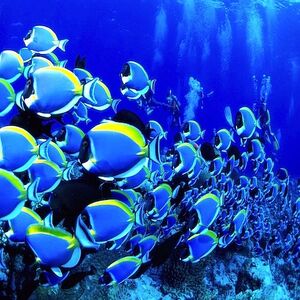
The Acanthurus japonicus, or Powder Brown Tang, is an Indo-West Pacific surgeonfish with a laterally compressed, oval body that can reach up to 21 cm in length. Its coloration varies based on its mood, from brown to blue to yellow, but it is distinguished by a prominent white band between the mouth and eye, a bright orange stripe on the dorsal fin, and a yellow band on the caudal peduncle. It is a herbivorous, territorial fish that typically lives in small to large aggregations in reef environments.
Physical description
Body shape: Oval and laterally compressed.
Size: Can grow up to 21 cm (8.3 in) in length.
Coloration:
The body color can range from brown to blue to yellow, depending on the fish's emotional state.
A wide, white band runs from the lower part of the eye to the upper lip.
A bright orange or pink band is present along the soft-rayed part of the dorsal fin.
The caudal peduncle is black with a yellow base.
Fins:
Dorsal fin: Has 9 spines and 28–31 soft rays.
Anal fin: Has 3 spines and 26–29 soft rays.
Caudal fin: Is truncate.
Pectoral fins: Have yellow bases.
Habitat and behavior
Habitat: Lives in clear lagoon and seaward reefs in the Indo-West Pacific, typically in shallow, exposed areas.
Diet: Herbivorous, feeding on algae and seaweed.
Social behavior: Can be found alone or in small to large aggregations. They are territorial and can be aggressive towards other fish, especially other tangs or conspecifics, which can lead to fights.
Oxycirrhites typus, or the Longnose Hawkfish, is a small marine fish known for its very long, pointed snout, white body, and a grid-like pattern of red stripes and bars. It typically grows up to 13 cm (5.1 inches) and has a tuft of cirri on its dorsal fin spines. The fish is often found perched on gorgonians and black corals in tropical reefs.
Key features
Appearance: White body with a network of horizontal and near-vertical red lines. Its most distinctive feature is a greatly elongated, pointed snout.
Dorsal fin: Has a tuft of cirri (small, hair-like projections) at the tip of each dorsal fin spine.
Size: Reaches a maximum length of 13 cm (5.1 inches).
Habitat: Inhabits tropical reefs in the Indo-Pacific region, often found at depths of 10 to 100 meters. It prefers to perch on gorgonian sea fans and black corals.
Behavior: Known to be a stationary hunter, observing its surroundings from a single perch. It is sometimes kept in the aquarium trade.
Diet: Primarily feeds on small crustaceans and zooplankton.
A "Designer Pair" of Amphiprion ocellaris, also known as clownfish, refers to a specific type of clownfish that has been selectively bred for unique color and pattern variations. These variations, Salvador Dali, Black Ice Snowflakes, or Snow Storms, are not naturally occurring and are the result of controlled breeding programs. These pairs are sold as a bonded unit, meaning they are two fish that the breeders have observed together and are likely to live harmoniously.
Here's a breakdown:
Selective Breeding:
Designer clownfish are the result of breeding programs that aim to produce specific color and pattern variations in the common Ocellaris clownfish.
Examples:
Black Storms are known for their black body with irregular white markings. Black Ice Snowflake clownfish are a cross between a Black Ocellaris and a Snowflake, exhibiting both black and snowflake-like patterns. Snow Storms are a result of breeding Black Storms and Black Snowflakes, displaying black fins, icy blue edges, and unique facial patterns.
Pairing:
Buying a "Designer Pair" ensures that the fish are likely to be compatible and not exhibit aggression towards each other, unlike randomly selected individual fish.
Reef Compatibility:
These designer clownfish are generally reef compatible, meaning they can be kept in a reef aquarium with corals and other invertebrates.
Symbiotic Relationship:
Clownfish are known for their symbiotic relationship with anemones, and designer strains, like their wild counterparts, can be housed with anemones like Bubble Tip anemones.
Captive Bred:
These fish are captive-bred, meaning they are raised in controlled environments, which often makes them more adaptable to aquarium life and less susceptible to diseases compared to wild-caught specimens.
The Yellow Belly Blue Tang, scientifically known as Paracanthurus hepatus, is a color variant of the popular Blue Tang, notable for its striking blue body and a yellow belly and tail. This variant also features a distinctive black marking on its upper body that forms a sort of "palette" design.
Key characteristics of the Yellow Belly Blue Tang:
Coloration: A vibrant blue body with a bright yellow tail and belly.
Markings: A black marking, shaped like a horizontal bar, extends from the back of the head, loops around the gills, and then extends back to the base of the tail.
Size: Can grow up to 8-12 inches (20-30 cm) in length.
Temperament: Generally peaceful but can become territorial and aggressive towards other tangs, especially when they mature.
Reef Compatibility: Reef safe, meaning they don't typically harm corals or other invertebrates.
Diet: Herbivorous, primarily consuming algae and marine plants.
Habitat: Found in coral reefs of the Indo-Pacific region.
Additional details:
The yellow coloration on the belly and tail is most prominent in adults, though even small juveniles may show some yellowing.
They are known for their active swimming and need a spacious aquarium with plenty of swimming room.
They are susceptible to certain diseases, particularly Ich, so maintaining good water quality and a healthy diet is crucial.
Their sharp tail spine (scalpel) is used for defense and can inflict a painful wound.
They require a varied diet, including algae-based foods, to maintain their health and reduce aggression.
The Ornate Leopard Wrasse (Macropharyngodon ornatus) is a colorful marine fish known for its intricate patterns and vibrant coloration. Adults typically display a mix of browns, yellows, and whites, with darker lines resembling a leopard's spots, hence the name. They exhibit sexual dimorphism, with males generally larger and more brightly colored than females.
Physical Characteristics:
Coloration: Adults have a reddish head, thorax, and abdomen with greenish-yellow bands and spots. The body is mostly covered in blackish shading. Males tend to be darker than females.
Spots and Lines: The distinctive "leopard" pattern is formed by darker lines on a lighter background.
Size: They typically reach a length of around 10-13 cm.
Sexual Dimorphism: Males are generally larger and more brightly colored than females.
Other notable features:
They inhabit lagoon and sheltered seaward reefs, often in areas with mixed sand, rubble, and coral.
They are found in the Indo-Pacific region, including Sri Lanka, western Australia, and Indonesia.
They are collected for the aquarium trade.
They are considered reef safe, but may consume small crustaceans and other invertebrates.
They require a sandy substrate to bury themselves in at night.