Двойка Nemateleotris magnifica (огненоподобно попче) обикновено се състои от един мъжки и една женска, често срещани да се реят близо до входа на дупка, като мъжкият пази яйцата, докато се излюпят. Мъжкият и женската са сходни на външен вид, но удълженият първи гръбначен шип на мъжкия може да е малко по-изпъкнал.
Специфични характеристики:
Външен вид:
Огненобялото попче е известно с отличителното си оцветяване: перленобяла предна половина, преходяща в оранжево-червена задна половина, и тъмночервена опашка. Първият гръбен шип е силно удължен и бял.
Поведение:
Те обикновено са мирни риби и прекарват по-голямата част от времето си, окачени близо до убежище, често дупка, чакайки малка плячка да се носи по течението.
Поведение на двойките:
В дивата природа те често живеят по двойки или малки групи, реейки се над рифа и активно ловувайки храна.
Диета:
Те са месоядни, хранят се със зоопланктон, малки безгръбначни, а в аквариуми лесно приемат саламура, скариди мизис и приготвени морски храни.
The Chromis viridis, commonly known as the blue-green chromis or green chromis, is a small, iridescent damselfish with a bright blue-green or apple-green coloration. They are known for their shimmering, almost iridescent appearance that changes based on light. Males may turn yellow to orange during spawning. They are found in the Indo-Pacific region, inhabiting coral reefs and lagoons.
Key characteristics:
Size: Typically reach a maximum length of 4 inches, but most stay around 3 inches.
Color: Shimmery, iridescent blue-green or apple-green.
Spawning coloration: Males may turn yellow to orange during mating season, sometimes with black coloration.
Habitat: Coral reefs and lagoons, typically in the shallows.
Social behavior: Form large schools, often above branching Acropora corals.
Aquarium suitability: Popular and easy to care for in saltwater aquariums.
Diet: Plankton feeders; readily accept a variety of foods, including flake food, frozen, and live foods.
Territoriality: Can be territorial, especially during mating, and may nip at other fish if crowded.
Natural habitat: Found throughout the Indo-Pacific region, from the African coast to the Pitcairn Islands.
Salarias fasciatus, известен още като скъпоценен бленни или косачка за трева, е малка, камуфлажна риба, която обикновено се среща в морска среда. Характеризира се с маслинено до кафяво оцветяване, с множество тъмни ивици и бели петна, и склонност да се слива със скали и корали. Може да достигне максимална дължина от 14 см.
Ето по-подробно описание:
Размер и форма:
Salarias fasciatus е сравнително малка риба, достигаща максимална дължина от 14 см (5,5 инча). Тя има удължена форма на тялото, като тялото е отчетливо по-дебело от главата.
Оцветяване и шарки:
Те проявяват пъстър или пясъчен цвят, често с тъмни ивици, бледи петна и ивици. Някои индивиди могат да имат и фини сини петна с тъмни очертания по задната част на тялото.
Структура на перките:
Гръбната и аналната им перка са прикрепени към основата на опашната перка чрез мембрана. Възрастните мъжки имат удължени предни лъчи на аналната перка.
Камуфлаж:
Оцветяването и шарките им са пригодени да се сливат с околната среда, което им позволява да се камуфлират с камъни, корали и чакъл.
Диета:
Въпреки че често са наричани „косачки за трева“ поради навиците си да се хранят с водорасли, те са предимно детритолози, като водораслите съставляват само малка част от диетата им.
Поведение:
Те са известни със своята личност и навика да „зашеметяват“ зрителите с големите си орбитални очи, докато изследват околната среда.
Синьоивичатият зеленоглав ( Labriodes dimidiatus ) е един от няколкото вида зеленоглави риби, срещащи се по кораловите рифове от Източна Африка и Червено море до Френска Полинезия . Подобно на други зеленоглави риби, той се храни с паразити и мъртви тъкани от кожата на по-големите риби в мутуалистични отношения , които осигуряват храна и защита за зеленоглавия рибка , както и значителни ползи за здравето на останалите риби . Забележително е и с това, че е възможно да е преминал теста с огледалото , макар че това не е безспорно.
Таксономия
Генетичен анализ на L. dimidiatus разкри, че популацията попада в две монофилетични групи. кладове , като популациите в Индийския океан обикновено имат различна ширина на ивиците от рибите в западната част на Тихия океан . Японските зеленоглави риби обаче попадат в същата група като рибите в Индийския океан, въпреки разликата във външния вид, и двата клада се припокриват около Папуа Нова Гвинея. Два тясно свързани вида чистачи, Labroides pectoralis и Labroides bicolor , са групирани в клада L. dimidiatus , така че синьоивичастият чистач може всъщност да е полифилетичен , включващ няколко вида .
Описание
Това е малък зеленоглав, средно дълъг 10 см (3,9 инча), най-много 14 см (5,5 инча). Може да се разпознае по широка надлъжна черна ивица, която минава по протежение на страната и окото; гърбът и коремът са бели (понякога леко жълтеникави). Тази бяла част променя цвета си в яркосиня отпред на животното, докато черната ивица се разширява към опашката. Малките са черни с електриковосиня линия.
Разпространение
Синьоивичатият чистач се среща по кораловите рифове в тропиците от Червено море и Индийския океан до западната част на Тихия океан (включително Папуа Нова Гвинея , Япония , Фиджи и Френска Полинезия ). [5] За първи път е регистриран в морския резерват на островите Кермадек северно от Нова Зеландия през 2015 г., след като изследователи са изследвали стотици часове неизползвани документални филмови кадри.
Почистване
Чистите рибки обикновено се срещат на почистващите станции . Почистващите станции са заети от различни групи чисти рибки, като например група млади, двойка възрастни или група женски, придружени от доминиращ мъжки. Когато посетителите се приближат до почистващите станции, чистите рибки ги поздравяват, като изпълняват танцуващо движение, при което движат задните си части нагоре и надолу. Посетителите се наричат „клиенти“. Чистачите от синьо-бели риби се почистват, за да консумират ектопаразити по рибите клиенти за храна. По-големите риби ги разпознават като чистачи, защото имат странична ивица по дължината на тялото си, и чрез моделите си на движение. Чистачите поздравяват посетителите в опит да си осигурят източник на храна и възможност за почистване с клиента. След като разпознае чистача и успешно привлече вниманието му, рибата клиент заема специфична за вида поза, за да позволи на чистача достъп до повърхността на тялото, хрилете и понякога устата си. [ необходим е цитат ] Други риби , които участват в такова поведение на почистване, включват попчета ( Elacatinus spp.) Известно е, че синьо-белият чистач почиства от семействата balaenopteridae , chondrichthyans , homaridae , octopodidae и dermochelyidae .
В различните региони, синьо-ивичатката чистачка показва различна степен на зависимост от ектопаразитите на клиентите си като основен източник на храна. В приливни среди, като например Големия бариерен риф , синьо-ивичатката чистачка е факултативен чистач, който се храни повече с корали, отколкото с рибни клиенти. Младите чистачи от синьо-бели ивици хапят клиентите си по-често от възрастните в този регион, като по този начин променят динамиката на познатата мутуалистична връзка. Въпреки това, в региони, където почистващите риби от вида „bluestreak“ зависят единствено от паразитите на клиентите си, рибите, които имат достъп до услуги за почистване, са в по-добро телесно състояние от тези, които нямат достъп до почистващи средства. В Марса Барейка в природния резерват Рас Мохамед, Египет , синьоивичатата чистачка живеят в специфични сектори на плитките рифове и е доказано, че разчитат на ектопаразити от видове като кафявата риба хирург и белокоремната дама . В този регион рибите, които посещават по-чисти риби, имат по-ниски антителни отговори от тези без достъп до по-чисти места, което предполага, че достъпът до по-чисти места може да намали необходимостта от активен имунитет.
Размножаване
Мъжките от породата чистачи защитават специфични територии за обитаване от други мъжки, в които те могат да контролират женските в тези територии. Когато доминиращият мъжки вече не съществува на тази територия, една от по-големите женски е в състояние да смени пола си, за да поеме контрол над нея.
Chrysiptera talboti, or Talbot's Demoiselle, is a small fish (up to 6 cm) characterized by a bright yellow head and pelvic fins, a purplish-grey body, and a prominent black spot on its dorsal fin. It has a distinctive black anal papilla, a pinkish tinge to its body, and is often found solitary in reef depressions.
Appearance
Body: Purplish-grey or pearly grey with a pinkish tinge.
Head and pelvic fins: Bright yellow.
Dorsal fin: A large black spot is located at the base of the spinous part of the dorsal fin, usually over the last four spines.
Anal fin: A black anal papilla is present.
Size: Reaches a maximum length of about 6 cm (2.4 inches).
Behavior and habitat
Habitat: Inhabits coral-rich areas, such as seaward reef slopes and deep lagoons.
Social behavior: Usually solitary, but can be found in groups in its natural habitat. In an aquarium, they are known to be territorial, especially as they mature, and may become aggressive toward other damselfish.
Activity: Active and diurnal (active during the day).
Temperament: Can range from peaceful to moderately aggressive, depending on age and environment.
Other characteristics
Diet: Feeds on zooplankton and planktonic crustaceans in its natural habitat. In captivity, they will accept flakes, pellets, and meaty foods.
Reproduction: Oviparous (egg-laying) and protandric hermaphrodites, meaning they are born male and change to female as they age
The Orangeback fairy-wrasse (Cirrhilabrus aurantidorsalis) is a small, colorful fish known for its vibrant orange back, which contrasts with a magenta stripe along its body and a shimmering belly. Males are more intensely colored, especially during courtship, and have a dark red "crown" marking. They inhabit coral reefs in the Indo-Pacific, live in small groups with one male and several females, and are popular in the aquarium trade for their peaceful nature and activity level.
Appearance
Coloration:
Has a brilliant orange or golden-orange back, a magenta stripe running the length of the body, and a belly that can be pink, blue, or purple.
Male features:
Males have more intense colors and a dark red crown-like marking on the head. During courtship, their colors intensify significantly.
Female features:
Females are less vibrant, with a reddish-brown body, white face, and white belly.
Body shape:
Slender and elongated body.
Habitat and behavior
Habitat:
Found in the Indo-Pacific, specifically in the eastern Tomini Bay and Lembeh Strait, on reef slopes and edges with rubble areas.
Social structure:
Lives in small groups (harems) consisting of one male and several females. All are believed to start as females, with some transforming into males.
Temperament:
Peaceful and active fish, making them suitable for reef aquariums. They are reef-safe and will not harm corals or invertebrates.
Jumping:
Known to be good jumpers, so a tight-fitting lid on the aquarium is essential.
Diet
Primary food: Zooplankton.
Aquarium diet: Readily accepts a variety of meaty foods, such as frozen mysis shrimp, brine shrimp, and other high-quality flakes, pellets, and frozen/live foods.
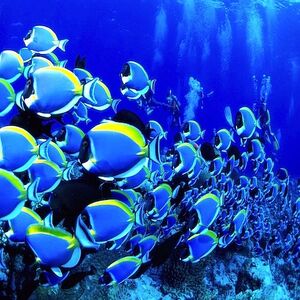
The Acanthurus japonicus, or Powder Brown Tang, is an Indo-West Pacific surgeonfish with a laterally compressed, oval body that can reach up to 21 cm in length. Its coloration varies based on its mood, from brown to blue to yellow, but it is distinguished by a prominent white band between the mouth and eye, a bright orange stripe on the dorsal fin, and a yellow band on the caudal peduncle. It is a herbivorous, territorial fish that typically lives in small to large aggregations in reef environments.
Physical description
Body shape: Oval and laterally compressed.
Size: Can grow up to 21 cm (8.3 in) in length.
Coloration:
The body color can range from brown to blue to yellow, depending on the fish's emotional state.
A wide, white band runs from the lower part of the eye to the upper lip.
A bright orange or pink band is present along the soft-rayed part of the dorsal fin.
The caudal peduncle is black with a yellow base.
Fins:
Dorsal fin: Has 9 spines and 28–31 soft rays.
Anal fin: Has 3 spines and 26–29 soft rays.
Caudal fin: Is truncate.
Pectoral fins: Have yellow bases.
Habitat and behavior
Habitat: Lives in clear lagoon and seaward reefs in the Indo-West Pacific, typically in shallow, exposed areas.
Diet: Herbivorous, feeding on algae and seaweed.
Social behavior: Can be found alone or in small to large aggregations. They are territorial and can be aggressive towards other fish, especially other tangs or conspecifics, which can lead to fights.
Oxycirrhites typus, or the Longnose Hawkfish, is a small marine fish known for its very long, pointed snout, white body, and a grid-like pattern of red stripes and bars. It typically grows up to 13 cm (5.1 inches) and has a tuft of cirri on its dorsal fin spines. The fish is often found perched on gorgonians and black corals in tropical reefs.
Key features
Appearance: White body with a network of horizontal and near-vertical red lines. Its most distinctive feature is a greatly elongated, pointed snout.
Dorsal fin: Has a tuft of cirri (small, hair-like projections) at the tip of each dorsal fin spine.
Size: Reaches a maximum length of 13 cm (5.1 inches).
Habitat: Inhabits tropical reefs in the Indo-Pacific region, often found at depths of 10 to 100 meters. It prefers to perch on gorgonian sea fans and black corals.
Behavior: Known to be a stationary hunter, observing its surroundings from a single perch. It is sometimes kept in the aquarium trade.
Diet: Primarily feeds on small crustaceans and zooplankton.
The Ocellated dragonet (Synchiropus ocellatus) is a small, colorful fish with a distinctive diamond-shaped body when viewed from above, and is known for its unique way of moving along the substrate using its pectoral fins. It typically grows to about 8 centimeters (3.1 inches) in length. Males are generally more brightly colored than females and have a large, sail-like dorsal fin, often orange at the base. The body is mottled with brown and white, sometimes with red highlights, and features a pattern of stripes or spots.
Here's a more detailed breakdown:
Appearance:
The fish has a mottled brown and white body, sometimes with red highlights. It has a large, boxy head and a diamond-shaped body when viewed from above.
Size:
It reaches a maximum length of about 8 centimeters (3.1 inches).
Coloration:
Males are generally more colorful than females, with a bright orange dorsal fin base. They also have a distinctive pattern of stripes or spots on their body.
Locomotion:
The Ocellated dragonet uses its pectoral fins to shuffle along the substrate, rather than swimming in a typical fish-like manner.
Habitat:
They are found in shallow waters, particularly on sandy areas of reefs and in tide pools.
Diet:
They are micropredators, feeding on small benthic invertebrates and zooplankton.
Aquarium Care:
In aquarium settings, they are known to be reef-safe, hardy, and stay small, making them popular with aquarists. However, they require a well-established aquarium with a constant supply of live zooplankton or other small foods, as they cannot eat large meals at once.
The Amphiprion percula, commonly known as the orange clownfish or percula clownfish, is a small, brightly colored marine fish characterized by its orange body and three distinctive white bands outlined in black. These bands are located behind the eyes, in the middle of the body (often with a forward-bulging section), and near the tail. The fins are also edged with black. They are often confused with the similar-looking Amphiprion ocellaris, but can be distinguished by the number of dorsal fin spines (10 in A. percula vs. 11 in A. ocellaris) and the thickness of the black outlining on the white bands.
Key Characteristics:
Coloration: Bright orange body with three white bands edged in black.
Bands: The first band is behind the eyes, the second in the middle of the body, and the third near the tail.
Size: Can grow up to 11 cm (4.3 inches) in length.
Dorsal Fin Spines: Typically 10.
Symbiotic Relationship: Lives in a symbiotic relationship with sea anemones, providing protection and receiving a safe habitat.
Social Structure: Organized in size-based hierarchies within anemones.
Sexual Dimorphism: Females are larger than males.
The ocellaris clownfish, or Amphiprion ocellaris, is a vibrant marine fish known for its striking orange body, three white bands, and black outlines. These fish, also called false percula clownfish or common clownfish, form a symbiotic relationship with sea anemones, using their mucus-covered skin to avoid being stung by the anemone's tentacles.
Physical Characteristics:
Color: Primarily bright orange with three distinct white bands.
Bands: The white bands are usually outlined in black. The middle band often has a rounded bulge in the middle.
Size: Typically grow to about 3-5 inches (8-11 cm) in length.
Fins: Black markings on the fins, particularly the dorsal fin, are common.
Other Notable Features:
Symbiotic Relationship:
They have a mutually beneficial relationship with sea anemones, living among their tentacles for protection from predators.
Protective Mucus:
A special layer of mucus on their skin protects them from the anemone's stinging cells.
Protandrous Hermaphrodites:
All begin life as males and can change to females as they mature, with the largest fish in a group typically being female.
Regional Variations:
While typically orange, some can be darker red-orange or even black with white bands, depending on their location.
Acanthurus olivaceus, the orange-band surgeonfish, the orange-shoulder surgeonfish or the orangebar tang,is a species of marine ray-finned fish belonging to the family Acanthuridae, this family includes the surgeonfishes, unicornfishes and tangs. It lives in the tropical waters of the Indo-west Pacific.
Taxonomy
Acanthurus olivaceus was first formally described in 1801 by the German naturalists Marcus Elieser Bloch and Johann Gottlob Theaenus Schneider with its type locality given as Tahiti in the Society Islands,This species is closely related to the range restricted Marquesas surgeonfish (A. reversus), and together these taxa form a species complex within the genus Acanthurus.The genus Acanthurus is one of two genera in the tribe Acanthurini which is one of three tribes in the subfamily Acanthurinae which is one of two subfamilies in the family Acanthuridae.
Description
The orange band surgeonfish is a deep-bodied, laterally-compressed oval fish, rather over twice as long as it is deep, with a maximum length of 35 cm (14 in), although a more typical length is 25 cm (10 in). Both dorsal and anal fins are long and low, extending as far as the caudal peduncle. The dorsal fin has nine spines and 23 to 25 soft rays while the anal fin has three spines and 22 to 24 soft rays. The tail fin is crescent-shaped, the points growing longer as the fish gets older. The adult fish is greyish-brown; a sharp vertical line usually separates the paler front half of the fish from the darker hind portion. There is a distinctive orange bar, surrounded by a purplish-black margin, immediately behind the top of the gill cover, and blue and orange lines at the bases of the fins. Like all surgeonfish, this species has a pair of scalpel-like scales that project upward from the caudal peduncle. Larger males develop a convex snout which clearly differentiates them from females. Juvenile fish are yellow.
Distribution and habitat
This fish is found in the tropical eastern Indian Ocean and the western Pacific Ocean. Its range extends from Christmas Island and the Cocos Keeling Islands to southern Japan, Western, Northern and Eastern Australia, Indonesia, the Philippines and Hawaii. It is associated with reefs, often on outer slopes and in more exposed locations. As an adult, it is a solitary fish or sometimes joins schools, with a depth range of between about 9 and 46 m (30 and 150 ft), but juveniles are found in shallower water in sheltered locations in small groups.
Ecology
The orange band surgeonfish feeds on detritus and on algae growing on the seabed, as well as the film of diatoms and filamentous algae that grows on sand and other substrates.[2] It often forms schools with parrotfish, tangs and other species of surgeonfish, which all have similar diets; their grazing is important in maintaining biodiversity by keeping rocks free from excessive growth of algae so that coral larvae can find suitable habitat to settle. The fish can change colour from dark to pale almost instantaneously.
Status
The orange band surgeonfish has a wide distribution in the tropical Indo-Pacific region and is moderately common. It is sometimes found in fish markets and in the aquarium trade but is not a species targeted by fisheries. No particular threats have been recognised.