


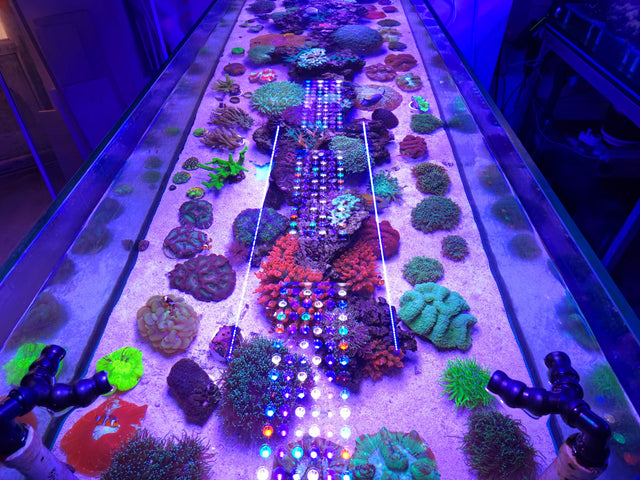
Соленоводна акваристика

Гониопора
Goniopora, also known as "flowerpot" or "daisy" coral, are Large Polyp Stony (LPS) corals characterized by their distinctive, daisy-like polyps and intense colors. These corals, often found in lagoons and turbid water conditions, are known for their vibrant hues of green, yellow, pink, or purple. Their polyps extend outward from the base, with each tipped by 24 stinging tentacles. While they can be stunning additions to reef tanks, Goniopora are considered delicate and can be challenging to keep in captivity. Key Features and Characteristics: Appearance: Goniopora corals have a characteristic flowerpot or daisy appearance due to their polyps, which are often brightly colored. Color: They come in a range of colors, including green, yellow, pink, and purple. Habitat: Found in lagoons and turbid water conditions. Polyps: Numerous daisy-like polyps extend outward from the base, each with 24 stinging tentacles. Sensitivity: Considered sensitive corals and can retract when disturbed. Feeding: Avid feeders and can be susceptible to nutritional deficiencies if not properly fed. Care Difficulty: Generally considered delicate and can be challenging to keep long-term in a reef tank. In a Reef Tank: Goniopora can be a beautiful addition to a reef tank, adding movement and elegance. They are moderate in care requirements and adaptability, making them suitable for intermediate reef keepers. Proper care, including stable water parameters, regular feeding, and moderate lighting and water flow, is crucial for their survival. Goniopora can be difficult to maintain in a home aquarium and are best suited for experienced reef keepers
€90,00

Австраломуса
Australomussa, scientifically named Parascolymia rowleyensis, is a type of large polyp stony coral (LPS) found in the Indo-Pacific region, particularly in Australia and Southeast Asia. These corals form flattened, dome-shaped colonies, with corallites characterized by shallow valleys and distinct color and texture differences between the septa and costae. They are known for their vibrant colors, which can range from blue-grey to bright reds, yellows, and greens. Detailed Description: Colony Structure: Australomussa corals grow into large, dome-shaped or helmet-shaped colonies, sometimes reaching several meters in size. Corallites: The corallites, which are the individual polyps, are subcerioid, meaning they have short, shallow valleys that are separated by thick walls. Tissue Color: The tissue over the septa (the radial plates within the corallites) is often a different color and/or texture compared to the tissue over the costae (the outer walls of the corallites). Habitat: These corals are typically found in lower reef slopes, where they are protected from strong wave action. Color: In north-west Australia, colonies often exhibit a uniform blue-grey color, while valleys may have concentric cream and green hues. In Southeast Asia, a wider range of colors, including bright red, yellow, and green, are commonly observed. Similar Species: The corallite details of Parascolymia rowleyensis are similar to those of Parascolymia vitiensis, another large polyp stony coral. Abundance: While they can be locally common in certain areas, Australomussa corals are not typically abundant.
€100,00

Бластомуса
price per one polyp Blastomussa are a genus of large polyp stony corals, also known as "pineapple corals," "swollen brain corals," or "mushroom corals". They are characterized by their fleshy, often brightly colored polyps and rounded, swollen structures. Blastomussa are relatively easy to care for and can be a stunning addition to a reef aquarium. Here's a more detailed description: Appearance and Structure: Polyp Type: Large polyp stony corals (LPS). Colonies: Form colonies with a small number of corallites, each with its own fleshy polyp. Color: Brightly colored, with common colors including red, green, blue, brown, and combinations of these. Skeletal Structure: The skeleton is generally compact and rounded, resembling a swollen or mushroom-like shape. Growth: They tend to grow in a phaceloid (branched) or subplocoid (slightly branched) manner. Habitat and Distribution: Location: Found in reef environments, particularly in the Indo-Pacific region. Depth: Can be found on lower reef slopes and in turbid environments. Care Requirements: Lighting: Generally prefer low to moderate light levels. Water Flow: Moderate water movement is recommended, but they can tolerate low flow. Feeding: Blastomussa are primarily symbiotic with zooxanthellae, obtaining a significant portion of their nutrition through photosynthesis. They will also feed on microplankton, brine shrimp, and krill. Water Parameters: Maintaining stable water quality is essential, including regular water changes. Species within the Genus: Blastomussa wellsi: A species with smaller corallites and fewer septa, often found in the Indo-Pacific. Blastomussa merleti: A species sometimes referred to as "pineapple coral," found in the west and central Indo-Pacific. Other species: Blastomussa vivida, Blastomussa omanensis, and Blastomussa loyae are also recognized within the genus. Caring for Blastomussa in a Reef Aquarium: Water Quality: Monitor water parameters regularly and perform regular water changes. Lighting: Provide appropriate lighting levels based on the species and specific needs. Feeding: Offer occasional feedings of appropriate foods, such as krill or mysis shrimp. Pruning and Fragging: Prune or frag as needed to control growth and prevent overcrowding. Pest Control: Monitor for potential pests and predators, such as coral-eating snails and nudibranchs. Tank Mates: Blastomussa are generally considered peaceful corals and can be housed with other non-aggressive corals.
€30,00
€0,00
€0,00

Турбинария
Turbinaria is a genus encompassing both brown algae and stony corals, each with distinct characteristics. Brown algae (like Turbinaria ornata) are marine organisms with an upright, tough thallus resembling a pinecone. They are often found in tropical waters, attached to rocks or coral heads, and can be invasive in some areas. Stony corals (like Turbinaria peltata) form colonies with corallites, which are the skeletal structures where polyps reside. They can be disc-shaped, vase-shaped, or plate-like, and are commonly found in reef environments. Brown Algae (Turbinaria): Appearance: Erect, radially branched, with blades or "laterals" that can be turbinate or peltate. The overall structure resembles a long pinecone. Habitat: Primarily found in tropical marine environments, especially coral reefs. Growth: Can be invasive in some areas, colonizing reefs and outcompeting other species. Examples: Turbinaria ornata (Crowded or Crowned Sea Bells) Stony Corals (Turbinaria): Appearance: Colonial, with corallites (skeletal structures) arranged in various forms like discs, vases, or plates. Habitat: Coral reefs in various depths and water conditions. Growth: Can form large colonies, sometimes dominating reef ecosystems. Examples: Turbinaria peltata (Disc Coral), Turbinaria mesenterina Key Differences: Structure: Brown algae have a thallus (non-animal tissue) with blades, while stony corals have a skeletal structure with corallites. Growth: Brown algae can fragment and reproduce vegetatively, while stony corals reproduce sexually. Invasiveness: Some brown algae species are considered invasive, while stony corals are generally not considered invasive.
€60,00

Еуфилия
Price per 1 polyp Euphyllia glabrescens, commonly known as Torch Coral, is a large-polyp stony coral characterized by its long, tubular polyps with knob-like tips and a range of colors, often bicolored with contrasting tentacle tips. These corals are colonial, with corallites (individual coral units) spaced apart and having thin, sharp-edged walls. Key features of Euphyllia glabrescens: Appearance: Long, tubular polyps resembling a torch, with a variety of colors including brown, green, pink, and fluorescent shades. Colony Structure: Phaceloid (corallites arranged in a branching pattern), with corallites 20-30 mm in diameter and spaced 15-30 mm apart. Tentacles: Large, tubular tentacles with knob-like tips. Color: Can be found in various colors, often with contrasting colors on the tentacles and polyp tips. Care: Suitable for intermediate-level reef keepers, requiring stable water parameters, moderate to high lighting, and moderate water flow. Feeding: While they can photosynthesize, they benefit from supplemental feeding with small meaty foods like zooplankton or coral-specific foods. Aggression: Can have sweeper tentacles that may harm neighboring corals, so they should be placed away from other corals. Compatibility: Clownfish often use torch corals as their home
€30,00

Стилофора
Stylophora pistillata, commonly called smooth cauliflower coral or hood coral, is a species of stony coral in the Indo-Pacific region. It has a branching growth form, with blunt-ended branches that thicken and become more massive as the colony matures. Corallites (the individual polyps' stony cups) are conical or hooded and partially submerged in the coenosteum (the stony framework of the colony). These corallites have a prominent, solid columella (the central column) and may have six primary and sometimes six secondary septa (stony plates forming the corallite wall). The coenosteum is covered in fine spinules. Colonies can be cream, pink, bluish, or green. Key features of Stylophora pistillata: Growth Form: Branching, with branches becoming thick and submassive. Corallites: Conical or hooded, with a prominent columella and septa. Colony Size: Up to 50 cm in diameter. Color: Cream, pink, bluish, or green. Habitat: Shallow water reef environments exposed to strong wave action. Distribution: Indo-Pacific region
€25,00
€0,00
€0,00

Акропора
Acropora corals are hard corals characterized by their branched or tabular morphology, fast growth rate, and high morphological plasticity. They are a vital functional group in coral reefs, creating complex habitats and covering hectares of reef surface. Here's a more detailed look: Key Characteristics: Growth Pattern: Acropora corals grow in colonies, with branches formed by axial and radial polyps. Habitat: They are typically found in shallow, clear, unpolluted water with ample light, temperature above 20°C, and constant salinity. Morphology: Their colonies can take on various forms, including arborescent (tree-like), table-like, corymbose (cushion-like), digitate (finger-like), hispidose, and encrusting. Importance: Acropora corals are crucial for building the structure of coral reefs and providing habitats for a variety of marine life. Factors Affecting Acropora: Water Quality: Clear, unpolluted water is essential for growth and survival. Lighting: They require ample light for their symbiotic algae (zooxanthellae) to photosynthesize. Temperature: Optimal temperatures above 20°C are needed. Salinity: Constant salinity levels are important.
€40,00

Ястребова риба
The Flame Hawkfish, Neocirrhites armatus, is a vibrant, small to medium-sized hawkfish known for its bright red body and black markings, particularly along the dorsal fin and around the eyes. It's a solitary, territorial species, often seen perching on corals and rocks, observing its environment. Key characteristics: Appearance: Bright red with dark markings, especially along the dorsal fin and around the eyes. Size: Reaches a maximum length of about 9 cm (3.5 inches). Habitat: Native to the Indo-Pacific region, found near coral reefs with currents. Behavior: Solitary and territorial, preferring to perch and observe from a vantage point rather than actively swim. Diet: Carnivorous, feeding on small crustaceans. Care: Requires a well-oxygenated water environment and can be finicky eaters at first. Lifespan: Can live for 5 years or more in captivity with proper care.
€150,00