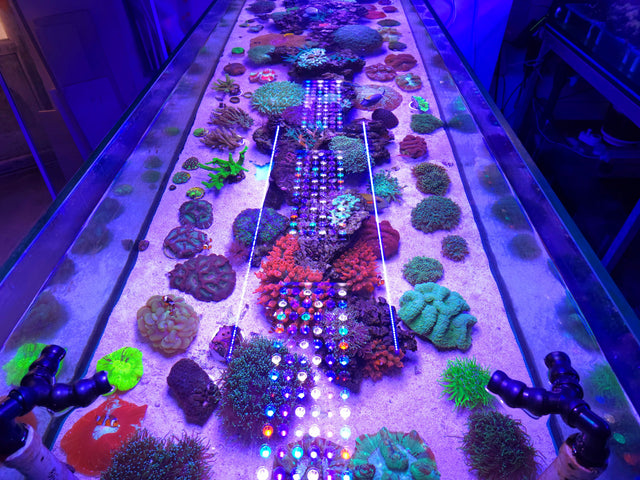
Fox coral, also known as Nemenzophyllia turbida, is a large polyp stony (LPS) coral. It's a peaceful coral with no visible tentacles, making it easy to maintain and suitable for both novice and experienced reef aquarists. Fox corals thrive in moderate lighting and low water movement, and benefit from the addition of calcium, strontium, and other trace elements in the water.
Here's a more detailed description:
Appearance:
Fox corals have a unique appearance with large, fleshy polyps that can extend significantly during the day. They lack visible tentacles and have a pale green or tan color.
Care:
Fox corals are relatively easy to care for, requiring moderate lighting, low water flow, and regular additions of calcium, strontium, and other trace elements.
Feeding:
They can benefit from additional food like micro-plankton or brine shrimp.
Fragility:
The fox coral's skeleton is quite fragile and needs to be handled with care.
Compatibility:
Fox corals are generally peaceful and don't typically pose a threat to other corals
Price per head
Euphyllia paradivisa, commonly called branching frogspawn coral, is a species of large-polyped stony coral native to the Indo-Pacific. It's known for its branching structure, where numerous polyps, each with large, hammer-shaped tentacles, extend from the main stem. These polyps typically display a pale greenish-grey or pink coloration, with lighter tentacle tips.
Here's a more detailed look:
Appearance:
Euphyllia paradivisa has a branching structure, resembling a small, delicate tree with multiple polyps. The polyps themselves are large and have tentacles with distinctive, hammer-shaped tips.
Coloration:
The coral's base color is often a pale greenish-grey, but it can also exhibit pink or even bicolor variations with purple tips and green stems. The tentacle tips are generally lighter than the main body of the polyp.
Habitat:
These corals are found in shallow reef environments, particularly in areas protected from strong wave action.
Care:
Euphyllia paradivisa is a popular species in the marine aquarium hobby, but it requires stable water parameters and moderate water flow. They are generally considered moderate to easy to keep, especially when provided with adequate light and a stable environment.
Fluorescence:
Many Euphyllia paradivisa corals on rockcorals.de exhibit fluorescence, particularly when illuminated with blue-dominated light.
Price per one polyp
Euphyllia glabrescens, commonly known as Torch Coral, is a large-polyp stony coral characterized by its long, tubular polyps with knob-like tips and a range of colors, often bicolored with contrasting tentacle tips. These corals are colonial, with corallites (individual coral units) spaced apart and having thin, sharp-edged walls.
Key features of Euphyllia glabrescens:
Appearance:
Long, tubular polyps resembling a torch, with a variety of colors including brown, green, pink, and fluorescent shades.
Colony Structure:
Phaceloid (corallites arranged in a branching pattern), with corallites 20-30 mm in diameter and spaced 15-30 mm apart.
Tentacles:
Large, tubular tentacles with knob-like tips.
Color:
Can be found in various colors, often with contrasting colors on the tentacles and polyp tips.
Care:
Suitable for intermediate-level reef keepers, requiring stable water parameters, moderate to high lighting, and moderate water flow.
Feeding:
While they can photosynthesize, they benefit from supplemental feeding with small meaty foods like zooplankton or coral-specific foods.
Aggression:
Can have sweeper tentacles that may harm neighboring corals, so they should be placed away from other corals.
Compatibility:
Clownfish often use torch corals as their home
Price per one polyp
Euphyllia glabrescens, commonly known as Torch Coral, is a large-polyp stony coral characterized by its long, tubular polyps with knob-like tips and a range of colors, often bicolored with contrasting tentacle tips. These corals are colonial, with corallites (individual coral units) spaced apart and having thin, sharp-edged walls.
Key features of Euphyllia glabrescens:
Appearance:
Long, tubular polyps resembling a torch, with a variety of colors including brown, green, pink, and fluorescent shades.
Colony Structure:
Phaceloid (corallites arranged in a branching pattern), with corallites 20-30 mm in diameter and spaced 15-30 mm apart.
Tentacles:
Large, tubular tentacles with knob-like tips.
Color:
Can be found in various colors, often with contrasting colors on the tentacles and polyp tips.
Care:
Suitable for intermediate-level reef keepers, requiring stable water parameters, moderate to high lighting, and moderate water flow.
Feeding:
While they can photosynthesize, they benefit from supplemental feeding with small meaty foods like zooplankton or coral-specific foods.
Aggression:
Can have sweeper tentacles that may harm neighboring corals, so they should be placed away from other corals.
Compatibility:
Clownfish often use torch corals as their home
Cynarina lacrymalis, commonly known as the flat cup coral, solitary cup coral, or cat's eye coral, is a large, solitary stony coral. It is cylindrical, with a diameter up to 10 cm and a height of 8 cm, and has a single polyp nestled in a corallite. The corallite is a stony cup that the coral has secreted.
Key Features:
Shape and Size: Cylindrical, with a round or oval upper surface.
Corallite: A stony cup secreted by the coral.
Attachment: Usually fixed to rock but can be embedded in sand or unattached.
Color: Various colors, including pale brown, green, pinkish, and bluish, depending on the species of zooxanthellae present.
Tentacles: Extended only at night.
Mantle: Translucent and inflated with water during the day, allowing visibility of the septa.
Habitat: Protected reef environments and deep sandy substrates.
Abundance: Not common, but conspicuous.
Nardoa galatheae, commonly known as the brown mesh sea star or green sea star, is a species of sea star belonging to the Ophidiasteridae family. It is found in the Indo-Pacific region, typically inhabiting coral reefs and rocky substrates at depths less than 30 meters. These sea stars are omnivores, feeding on detritus, small invertebrates, and algae.
Key Features of Nardoa galatheae:
Appearance: They have a characteristic five-armed formation with a mottled, greenish-brown color.
Habitat: N. galatheae prefers shallow rocky reefs, sandy substrates, and areas with live rock containing algae.
Diet: They feed on detritus, small microbes, algae, and may also consume small invertebrates.
Aquarium Care: These sea stars are not tolerant of sudden changes in water chemistry and should be drip-acclimated. They also cannot tolerate copper-based medications.
Size: They typically grow to an average of 25 cm in diameter.
Distribution: They are found in the Indo-Pacific region.
Condylactis gigantea, also known as the Giant Caribbean Sea Anemone or Atlantic Anemone, is a large, columnar anemone found in shallow waters of the Caribbean Sea and western Atlantic Ocean. These anemones can be white, light blue, pink, orange, pale red, or light brown, with numerous tentacles, each often having a pink, scarlet, blue, or green-ringed tip. They can grow to be over 30 cm in diameter.
Key Features:
Size and Shape: Large, columnar body with a large diameter.
Color: Can be white, light blue, pink, orange, pale red, or light brown.
Tentacles: Numerous tentacles, often with colored tips.
Habitat: Shallow reefs, grass beds, and lagoons in the Caribbean and western Atlantic.
Diet: Carnivorous, feeding on small invertebrates, fish, shrimp, and zooplankton.
Reproduction: Dioecious (separate sexes) with a primary mating season in spring.
Defensive Mechanism: Possesses cnidocysts (stinging cells) on the tips of its tentacles.
Heteractis crispa, commonly called the Sebae anemone or leather anemone, is a large, striking sea anemone native to the Indo-Pacific region. These anemones are known for their leathery tentacles, vibrant colors (ranging from white to brown, green, purple, or combinations), and their symbiotic relationship with certain clownfish species. They can grow up to 50 cm in diameter and are popular in aquariums.
Key Features of Heteractis crispa:
Appearance: Large, with a leathery, wavy body and long tentacles. The tentacles often have blue or purple tips.
Color: Varied, including shades of white, beige, brown, green, purple, or combinations.
Symbiosis: Forms symbiotic relationships with various anemonefish species, providing shelter and protection.
Habitat: Found in shallow, tropical waters, especially on coral reefs.
Diet: Predatory, feeding on small fish and invertebrates. They can also obtain food from algae that live within them.
Size: Can reach a diameter of 20-50 cm.
Heteractis crispa, commonly called the Sebae anemone or leather anemone, is a large, striking sea anemone native to the Indo-Pacific region. These anemones are known for their leathery tentacles, vibrant colors (ranging from white to brown, green, purple, or combinations), and their symbiotic relationship with certain clownfish species. They can grow up to 50 cm in diameter and are popular in aquariums.
Key Features of Heteractis crispa:
Appearance: Large, with a leathery, wavy body and long tentacles. The tentacles often have blue or purple tips.
Color: Varied, including shades of white, beige, brown, green, purple, or combinations.
Symbiosis: Forms symbiotic relationships with various anemonefish species, providing shelter and protection.
Habitat: Found in shallow, tropical waters, especially on coral reefs.
Diet: Predatory, feeding on small fish and invertebrates. They can also obtain food from algae that live within them.
Size: Can reach a diameter of 20-50 cm.
Heteractis crispa, commonly called the Sebae anemone or leather anemone, is a large, striking sea anemone native to the Indo-Pacific region. These anemones are known for their leathery tentacles, vibrant colors (ranging from white to brown, green, purple, or combinations), and their symbiotic relationship with certain clownfish species. They can grow up to 50 cm in diameter and are popular in aquariums.
Key Features of Heteractis crispa:
Appearance: Large, with a leathery, wavy body and long tentacles. The tentacles often have blue or purple tips.
Color: Varied, including shades of white, beige, brown, green, purple, or combinations.
Symbiosis: Forms symbiotic relationships with various anemonefish species, providing shelter and protection.
Habitat: Found in shallow, tropical waters, especially on coral reefs.
Diet: Predatory, feeding on small fish and invertebrates. They can also obtain food from algae that live within them.
Size: Can reach a diameter of 20-50 cm.
Price per branching frag
Cladiella are a genus of soft coral belonging to the family Alcyoniidae. They are known for their distinctive finger-like projections, which can be round or cone-shaped, extending from a short stalk. These projections branch in various directions and have polyps extending from their tips. Cladiella are hardy, fast-growing corals that can grow up to 41 cm in height. They are often pale in color, with contrasting brown or greenish-brown polyps. They are also known to be slimy to the touch due to the production of mucus.
Here's a more detailed description:
Appearance:
Cladiella have a leathery, smooth base tissue, which can be pale or white, often with an orangey-pink central column. The finger-like projections are the most noticeable feature, with polyps extending from their tips.
Color:
The base tissue is typically pale or white, while the polyps can be brown or greenish due to the presence of zooxanthellae (symbiotic algae). Some species, like Cladiella australis, are known to appear brown with extended polyps but turn white when the polyps retract.
Growth:
Cladiella are relatively fast-growing corals, with some species reaching up to 41 cm in height.
Habitat:
Cladiella are commonly found in the Indo-Pacific region.
Care:
Cladiella are relatively easy to keep in a reef aquarium and are often recommended for beginners. They prefer a moderate to strong current and are adaptable to varying water parameters.
Other notable features:
They are known for their hardiness and can be found in a variety of colors, including pink, red, and purple.
Price pre polyp
Discosoma sp. ferugata refers to a specific variety of mushroom coral with a vibrant green color, often described as a "metallic" or "fluorescent" green. They are known for their mushroom-like appearance and relatively low care requirements, making them a popular choice for reef aquariums.
Here's a more detailed description:
Appearance:
Discosoma sp. Electric Green are known for their distinctive green color, often described as a vibrant or metallic hue. They have a disc-shaped appearance and can grow to be quite large, up to 4 inches in diameter, .
Care:
They are generally easy to care for, preferring low to moderate lighting and water flow. They are also relatively tolerant of different water parameters.
Habitat:
Discosoma sp. are naturally found in warm waters throughout the Indo-Pacific, Caribbean, and tropical West Atlantic. They can be found in a variety of reef habitats, including intertidal zones and sheltered reefs.
Feeding:
They primarily feed on the products of their symbiotic zooxanthellae, but can also supplement their diet with dissolved organic matter and particulate matter from the water column. Some may also eat small fish or food particles.
Other notes:
Discosoma sp. are a part of the Corallimorpharia order, which is also related to sea anemones.They are often referred to as "mushroom corals" due to their shape.