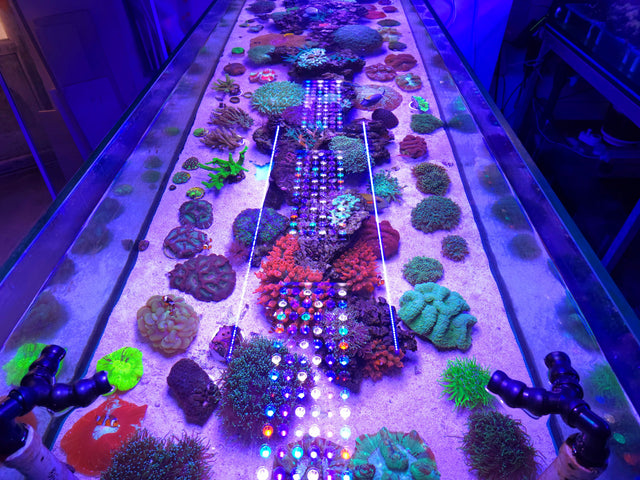
Micromussa, formerly known as Acanthastrea, are large polyp stony (LPS) corals popular in reef aquariums. They are known for their vibrant colors and relatively easy care requirements. Two common species are Micromussa lordhowensis (formerly Acanthastrea lordhowensis) and Micromussa amakusensis, distinguished by polyp size, with lords having larger polyps.
General Characteristics:
Colonial:
Micromussa form colonies of individual polyps, often with a massive, cerioid (forming a tight, even surface) structure.
Corallites:
The individual polyp cups (corallites) vary in size, with lords having larger corallites than micros.
Septa:
The septa (radiating plates within the corallite) are prominent, sometimes with beaded edges or teeth.
Columella:
The central structure within the corallite (columella) can be well-developed or poorly developed.
Fleshy Tissue:
A thick, fleshy mantle often covers the skeleton, sometimes with papillae (small projections).
Color:
Micromussa display a wide range of colors, including red, orange, purple, blue, and green, often with contrasting colors in the corallite walls.
Specific Species:
Micromussa lordhowensis:
Known for its large corallites (up to 15mm) and varied color patterns, often with two contrasting shades.
Micromussa amakusensis:
Has smaller, angular corallites and is often found with a thick fleshy mantle covered in papillae.
Care Requirements:
Lighting:
Micromussa generally prefer low to moderate lighting conditions, with some species being susceptible to bleaching or color changes from intense light.
Water Flow:
Moderate flow is recommended to prevent detritus buildup while still allowing the coral to extend its tentacles for feeding.
Feeding:
Micromussa are opportunistic feeders and benefit from target feeding with meaty foods like mysis shrimp, krill, or small pellets.
Placement:
Due to their potential for aggression and long sweeper tentacles, Micromussa should be given ample space and kept away from other corals.
Acclimation:
Proper acclimation is crucial when introducing new Micromussa to an aquarium.
Aggression:
Micromussa can be aggressive towards other corals, so adequate spacing is important.
Lobophyllia corals are large polyp stony (LPS) corals known for their vibrant colors and distinctive, fleshy polyps that can retract into stony cups called corallites. These corals are typically found in reef environments throughout the Indo-Pacific region and are popular in the aquarium hobby due to their appearance and moderate care requirements.
Key Characteristics:
Growth Form:
Lobophyllia corals can grow into hemispherical or flattened mounds, sometimes forming large, composite colonies.
Corallites:
They have prominent corallites, which are the stony cups that house the individual polyps. These can be either phaceloid (tubular and growing from a common base) or flabello-meandroid (arranged in valleys).
Polyps:
The polyps are large and fleshy, with a thick mantle that often obscures the underlying corallite structure.
Septa:
Each corallite contains septa, which are vertical blades that have sharp, tooth-like projections.
Coloration:
Lobophyllia corals exhibit a wide range of colors, including shades of gray, pink, violet, and yellowish-brown, sometimes with contrasting patterns.
Habitat:
They are found on coral reefs in the Indo-Pacific, from shallow reef slopes to deeper areas.
Aquarium Keeping:
Lobophyllia corals are moderately challenging to keep in aquariums and are considered a popular choice for reef tanks.
Specific Examples:
Lobophyllia corymbosa:
Forms flat sheets or hemispherical domes, with individual lobes united at their bases. Its corallites have distinct walls and numerous radiating septa.
Lobophyllia hemprichii:
Can form large, hemispherical or flattened mounds, sometimes with multiple colonies growing together. Its corallites can be phaceloid or flabello-meandroid.
Lobophyllia flabelliformis:
Known for its flabello-meandroid growth form, with closely compacted elongate valleys.
Symphyllia is a genus of large polyp stony (LPS) corals, characterized by their massive, dome-shaped or flat colonies with meandroid (brain-like) corallites. These corals are known for their diverse colors and patterns, often with contrasting colors between valley floors and walls. While the genus name Symphyllia is no longer taxonomically valid, with most species now classified under Lobophyllia, it's still used for CITES purposes.
Key characteristics of Symphyllia:
Colony Shape: Typically massive, dome-shaped, or flat, with meandroid valleys.
Corallites: Flabello-meandroid (brain-like), with ridges separating valleys, often with contrasting colors.
Polyps: Each corallite houses multiple polyps, indicated by the many mouth openings.
Color: Wide range of colors, often mottled, with contrasting colors between valley floors and walls.
Tentacles: They have long sweeper tentacles that can extend to sting other corals.
Habitat: Found on reef slopes and in protected areas of reefs.
Taxonomy: While the genus Symphyllia is no longer valid, it's still used for CITES (Convention on International Trade in Endangered Species) purposes, and many species have been reassigned to Lobophyllia.
Examples of Symphyllia species:
Symphyllia valenciennesi (now often classified under Lobophyllia), Symphyllia wilsoni (now often classified under Australophyllia), Symphyllia radians, Symphyllia agaricia, and Symphyllia recta.
Distinguishing Symphyllia from Lobophyllia:
Corallite Size and Structure:
Symphyllia species generally have larger, more branched corallites with more mouth openings compared to Lobophyllia.
Valley Ridges:
Symphyllia corallites often exhibit ridges dividing the interior surface (like a brain coral), while Lobophyllia corallites are often more separated.
Micromussa, formerly known as Acanthastrea, is a popular large polyp stony (LPS) coral in the reef aquarium hobby, known for its vibrant colors and relative hardiness. Two commonly seen species are Micromussa lordhowensis and Micromussa amakusensis, distinguished by polyp size. They thrive in low to moderate light and moderate water flow, benefit from target feeding, and can be aggressive, so they need space from other corals.
Key characteristics of Micromussa corals:
Colony Formation:
Micromussa forms massive, cerioid (closely packed, adjoining corallites) colonies.
Corallites:
The individual corallites (the structures housing the polyps) are typically circular or angular, and vary in size depending on the species. For example, M. lordhowensis has larger corallites than M. amakusensis.
Septa:
The septa (walls within the corallites) are thick and beaded or toothed.
Columella:
The columella (a central structure within the corallite) is typically poorly developed.
Fleshy Tissue:
Micromussa colonies have a thick fleshy mantle, sometimes covered with fine papillae (small projections).
Color:
Micromussa corals exhibit a wide range of colors, including red, orange, purple, blue, and green, often with contrasting colors in the corallite walls and fleshy tissue.
Aggression:
Micromussa corals can be aggressive, extending sweeper tentacles to sting neighboring corals.
Care requirements:
Lighting:
Micromussa corals generally prefer low to moderate light, as intense lighting can cause color changes.
Water Flow:
Moderate water flow is recommended, enough to prevent detritus buildup but not so strong as to damage the coral or prevent polyp extension.
Feeding:
Micromussa corals readily accept meaty foods like mysis shrimp and brine shrimp, and can also be target-fed with small pellets.
Space:
Due to their aggressive nature, Micromussa corals need to be provided with adequate space away from other corals.
In summary, Micromussa corals are attractive, relatively hardy additions to reef aquariums, requiring specific lighting, flow, and feeding, as well as careful consideration of their aggressive tendencies.
Lobophyllia hemprichii, commonly called lobed brain coral or largebrain root coral, is a large polyp stony coral known for its vibrant colors and fleshy texture. It forms colonies that can be flat to hemispherical, reaching diameters up to 5 meters. These colonies can consist of multiple adjacent colonies, sometimes of different colors, fused together. The coral's skeletal structure (corallites) can be tubular or arranged in valleys with ridges, and the septa (vertical blades within the corallite) have tall, sharp teeth. It is a zooxanthellate coral, meaning it hosts symbiotic algae that provide it with nutrients through photosynthesis.
Here's a more detailed breakdown:
Growth Form:
Lobophyllia hemprichii forms colonies that can be flat or hemispherical, with individual corallites that may be tubular (phaceloid) or arranged in valleys (flabello-meandroid).
Corallite Structure:
The corallites, which are the skeletal cups that house the polyps, can be tubular or arranged in valleys with ridges. Septa, the vertical blades within the corallite, taper in thickness and have prominent, sharp teeth.
Polyps:
The polyps are thick and fleshy, able to retract into the corallites or extend their tentacles to feed. They can have either smooth or rough surfaces.
Coloration:
Lobophyllia hemprichii exhibits a variety of colors, including shades of gray, pink, violet, or yellowish-brown. Some colonies may have a uniform color, while others display multiple colors concentrated around the mouths or valleys.
Habitat:
It's commonly found in the Indo-Pacific region, particularly on upper reef slopes, where it can form large, dominant stands.
Symbiosis:
Like many corals, L. hemprichii is zooxanthellate, meaning it harbors symbiotic algae (dinoflagellates) within its tissues, which provide it with nutrients through photosynthesis.
Aggression:
It's known to be a somewhat aggressive coral, capable of extending sweeper tentacles to defend its space.
Lobophyllia hemprichii, commonly called lobed brain coral or largebrain root coral, is a large polyp stony coral known for its vibrant colors and fleshy texture. It forms colonies that can be flat to hemispherical, reaching diameters up to 5 meters. These colonies can consist of multiple adjacent colonies, sometimes of different colors, fused together. The coral's skeletal structure (corallites) can be tubular or arranged in valleys with ridges, and the septa (vertical blades within the corallite) have tall, sharp teeth. It is a zooxanthellate coral, meaning it hosts symbiotic algae that provide it with nutrients through photosynthesis.
Here's a more detailed breakdown:
Growth Form:
Lobophyllia hemprichii forms colonies that can be flat or hemispherical, with individual corallites that may be tubular (phaceloid) or arranged in valleys (flabello-meandroid).
Corallite Structure:
The corallites, which are the skeletal cups that house the polyps, can be tubular or arranged in valleys with ridges. Septa, the vertical blades within the corallite, taper in thickness and have prominent, sharp teeth.
Polyps:
The polyps are thick and fleshy, able to retract into the corallites or extend their tentacles to feed. They can have either smooth or rough surfaces.
Coloration:
Lobophyllia hemprichii exhibits a variety of colors, including shades of gray, pink, violet, or yellowish-brown. Some colonies may have a uniform color, while others display multiple colors concentrated around the mouths or valleys.
Habitat:
It's commonly found in the Indo-Pacific region, particularly on upper reef slopes, where it can form large, dominant stands.
Symbiosis:
Like many corals, L. hemprichii is zooxanthellate, meaning it harbors symbiotic algae (dinoflagellates) within its tissues, which provide it with nutrients through photosynthesis.
Aggression:
It's known to be a somewhat aggressive coral, capable of extending sweeper tentacles to defend its space.
Price per frag
Colpophyllia natans, commonly known as boulder brain coral or large-grooved brain coral, is a species of stony coral found in the Caribbean Sea and the Gulf of Mexico. It's characterized by large, rounded colonies, often resembling a brain, with a distinctive meandering pattern of ridges and valleys on its surface. The ridges are typically grey, while the valleys are green, whitish, or tan.
Here's a more detailed description:
Colony Shape and Size:
Colonies are large and can be either hemispherical or encrusting. They can grow up to 2 meters in diameter.
Surface Morphology:
The surface of the coral features a network of ridges and valleys that resemble a brain, hence the common name.
Coloration:
The ridges are generally brown, while the valleys are green, whitish, or tan.
Habitat:
Colpophyllia natans is typically found on reef slopes and tops, at depths of up to 50 meters.
Other Characteristics:
The coral has exsert, equal, and finely toothed septa. It also has a fine ambulacral groove along the tops of the walls.
Price per Polyp
Fimbriaphyllia paraancora, also known as anchor coral, is a branching stony coral characterized by large polyps with distinctive anchor or hammer-shaped tips on their tentacles. These corals are found in the Indo-West Pacific region, particularly in Indonesia, and thrive in shallow reef environments. They are colonial, with each branch originating from a single corallite.
Here's a more detailed description:
Appearance:
Fimbriaphyllia paraancora features large polyps that extend from branching corallites. The most notable characteristic is the shape of their tentacles, which have anchor or hammer-shaped tips, often forming concentric circles.
Color:
The tentacles can vary in color, ranging from pale tan to greenish-brown, and can also be bright green or gold.
Skeleton:
The skeleton of Fimbriaphyllia paraancora is similar to that of Euphyllia glabrescens, with corallites measuring 20-40 millimeters in diameter.
Habitat:
They are commonly found in the shallow waters of Indo-Pacific reefs, particularly in Indonesia.
Classification:
Originally classified under the genus Euphyllia, molecular studies led to its reclassification into the genus Fimbriaphyllia.
Other names:
Besides "anchor coral," it may also be referred to as "hammer coral" or, sometimes, by its former name, Euphyllia paraancora.
Price per polyp
Candy Cane coral or Caulastrea, is a popular, beginner-friendly large polyp stony (LPS) coral, characterized by its bright green, trumpet-shaped polyps. These polyps grow in clusters from a branching skeleton, creating a visually appealing structure. They are known for their hardiness and ability to add a vibrant pop of color to reef aquariums.
Key characteristics:
Appearance: The coral has a branching skeleton with trumpet-shaped polyps that are typically a vibrant neon green.
Polyp Structure: Each polyp has a central mouth surrounded by tentacles, and they can expand significantly, sometimes resembling a closed brain coral.
Hardiness: Green trumpet corals are considered hardy and relatively easy to care for, making them a good choice for beginners.
Lighting and Flow: They generally thrive under moderate lighting and moderate water flow.
Aggression: They have short sweeper tentacles, but are generally considered peaceful and can be placed near other corals, provided there's enough space to prevent them from touching.
Growth: They tend to grow at a moderate pace, forming dense colonies over time.
Water Conditions: Stable water conditions with appropriate levels of calcium, strontium, and other trace elements are important for their health.
In summary, the green trumpet coral is a visually appealing and relatively easy-to-care-for coral, making it a popular choice for reef aquarists of all experience levels.
The Pajama Cardinalfish, scientifically known as Sphaeramia nematoptera, is a popular saltwater aquarium fish known for its vibrant colors and peaceful nature. It features a greenish-yellow face, bright orange eyes, and a silver body with a bold black band across the midsection. The posterior part of its body is adorned with orange polka dots. These fish are relatively small, typically reaching a maximum size of 3 inches (8 cm).
Here's a more detailed description:
Appearance:
Coloration:
The Pajama Cardinal has a striking appearance with a greenish-yellow face, bright orange eyes, and a silver body.
Markings:
A prominent black band runs across the midsection, and the posterior of the body is dotted with orange polka dots. These dots are black in juveniles and turn red as they mature.
Fins:
The fish has distinctive tail fins.
Size:
They are relatively small, typically reaching a maximum length of 3 inches (8 cm).
Behavior:
Peaceful:
Pajama Cardinals are known for their peaceful nature and are suitable for community saltwater aquariums.
Schooling:
They thrive in small groups or schools within a larger aquarium.
Hierarchy:
While they establish dominance hierarchies when kept in groups, they don't typically rely on aggression to assert their position.
Nocturnal:
They are most active during twilight hours and during the night, when they disperse to hunt.
Care:
Reef-safe:
Pajama Cardinals are generally considered reef-safe and do not harm corals or invertebrates.
Diet:
They are omnivores and readily accept a variety of high-quality frozen foods, pellets, and live foods.
Tank Size:
A minimum of 20 gallons is recommended for a small group of Pajama Cardinals.
Compatibility:
They should be housed with other peaceful tankmates to avoid any aggression.
Additional Facts:
Mouth Brooders: Like other cardinalfish, they are mouth brooders, with the males incubating the eggs in their mouths.
Difficult to Sex: It's difficult to distinguish between males and females based on appearance alone.
Origin: They are found in the Indo-Pacific region.
The Bicolor Blenny (Ecsenius bicolor) is a popular saltwater aquarium fish known for its distinctive two-toned coloration, typically blue or dark brown in the front half and orange or yellow in the back. They are relatively hardy, peaceful, and have engaging personalities, making them a good addition to many reef aquariums.
Key characteristics:
Appearance:
The most prominent feature is the color division, with the front half of the body displaying a blue to dull brown hue, while the posterior half is orange or yellow. Males may exhibit more vibrant colors, especially when breeding.
Size:
They typically grow to about 4 inches (10 cm) in length.
Temperament:
Generally peaceful, but can be territorial towards other blennies, gobies, and dartfish in smaller tanks.
Habitat:
Found in Indo-Pacific reefs, they are bottom-dwelling fish, often found among rocks and crevices.
Diet:
Bicolor Blennies are primarily herbivores, consuming algae and plant matter. They will also graze on algae growing in the aquarium and should be offered a varied diet including algae-based foods.
Reef Compatibility:
They are generally considered reef safe, but may nip at clams or large polyp stony corals in smaller setups or when underfed.
Aquarium Requirements:
A tank of at least 30 gallons is recommended, with plenty of rocks for perching and hiding.
In aquariums:
Bicolor Blennies are known for their active and curious personalities, often seen hopping from rock to rock, exploring their environment. They are a great addition to larger reef tanks where they can help control algae growth and provide entertainment with their antics.
The sugar cane shrimp, scientifically known as Parhippolyte uveae, is a small shrimp species characterized by its translucent body and distinctive markings. It inhabits caves and anchialine pools in the Indo-Pacific region, including areas like the Indian and western Pacific Oceans. These shrimps are generally peaceful and thrive in reef-style aquariums with plenty of hiding spaces.
Appearance:
Size: They typically grow to about 5 cm in length.
Coloration: The body is red with shades of white
Habitat: They are commonly found in caves, often in shallow coral reef environments, and sometimes in anchialine pools.
Behavior:
Activity: Some populations, like those in Kakaban Island, are photophobic, meaning they are most active at night. Others, like those in the Philippines, are considered "sun-lovers" and are more active during the day.
Diet: Sugar cane shrimp are omnivores, preferring meaty foods like brine shrimp, mysis, and phytoplankton.
Temperament: They are generally peaceful and safe for reef and fish-only aquariums.
Other Names:
They are also known as the Red Sugar Cane Shrimp or Red Prawn.
Aquarium Care:
Tank Size: A 10-gallon tank is generally recommended.
Environment: They do well in reef or fish-only aquariums and are coral and fish safe.
Acclimation: Shrimp are sensitive to changes in salinity, so proper acclimation is important.