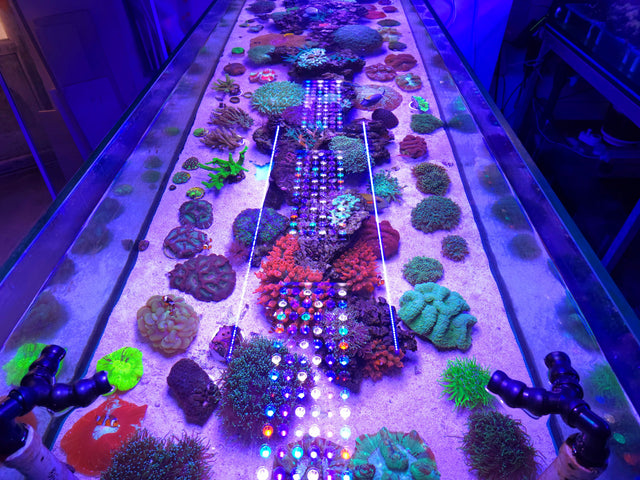
The Purple Firefish (Nemateleotris decora) is a vibrant dartfish characterized by its slender, elongated body, often white or yellow, that transitions to a darker shade towards the tail. Its most striking feature is its purple head and face, which contrasts with the reddish-orange or maroon hues on its fins, often edged with black. It's a relatively small fish, reaching about 3.5 to 4 inches in length, and is known for its peaceful temperament and reef compatibility.
Key characteristics:
Appearance: White or yellow body, purple head, reddish-orange or maroon fins with black edging.
Size: Reaches a maximum length of 9 cm (3.5 inches).
Habitat: Found in tropical Indo-West Pacific waters, from Mauritius to Samoa.
Temperament: Peaceful and reef compatible.
Diet: Feeds on zooplankton, especially copepods and crustacean larvae.
Behavior: Often found in pairs, hovering in the water column, and darting into holes when alarmed.
The Bicolor Blenny (Ecsenius bicolor) is a popular saltwater aquarium fish known for its distinctive two-toned coloration, typically blue or dark brown in the front half and orange or yellow in the back. They are relatively hardy, peaceful, and have engaging personalities, making them a good addition to many reef aquariums.
Key characteristics:
Appearance:
The most prominent feature is the color division, with the front half of the body displaying a blue to dull brown hue, while the posterior half is orange or yellow. Males may exhibit more vibrant colors, especially when breeding.
Size:
They typically grow to about 4 inches (10 cm) in length.
Temperament:
Generally peaceful, but can be territorial towards other blennies, gobies, and dartfish in smaller tanks.
Habitat:
Found in Indo-Pacific reefs, they are bottom-dwelling fish, often found among rocks and crevices.
Diet:
Bicolor Blennies are primarily herbivores, consuming algae and plant matter. They will also graze on algae growing in the aquarium and should be offered a varied diet including algae-based foods.
Reef Compatibility:
They are generally considered reef safe, but may nip at clams or large polyp stony corals in smaller setups or when underfed.
Aquarium Requirements:
A tank of at least 30 gallons is recommended, with plenty of rocks for perching and hiding.
In aquariums:
Bicolor Blennies are known for their active and curious personalities, often seen hopping from rock to rock, exploring their environment. They are a great addition to larger reef tanks where they can help control algae growth and provide entertainment with their antics.
Percnon gibbesi, commonly known as the Sally Lightfoot Crab or Nimble Spray Crab, is a marine crab species characterized by its very flat, thin, and wide carapace (shell). It has a distinctive red to brown coloration, sometimes with fine green marbling, and legs with yellow rings at the joints. Adults can reach a carapace width of about 30 millimeters (1.2 inches). They are known for their agility and speed, especially in their natural rocky habitat.
Physical Characteristics:
Carapace: Flat and thin, with a width of about 30mm.
Coloration: Varies from red to brown, sometimes with green marbling.
Legs: Long and flattened, with yellow rings at the joints.
Spines: Each of the five pairs of walking legs has a row of spines along the leading edge.
Habitat and Behavior:
Percnon gibbesi is native to the Eastern Atlantic, the Mediterranean, and the Canary Islands.
It is considered an invasive species in many parts of the Mediterranean.
It is commonly found in rocky, intertidal and subtidal zones, often hiding under rocks and in crevices.
They are known for their scavenging behavior, feeding on algae, detritus, and small invertebrates.
While generally reef-safe, larger individuals can become aggressive and may prey on small fish and other invertebrates
Echinophyllia is a genus of large polyp stony corals (LPS), also known as chalice corals, found in the Indo-Pacific and Red Sea. These corals are colonial and foliaceous, with thin, often plate-like or encrusting colonies. They are popular in reef aquariums due to their relatively easy care and various color variations.
Here's a more detailed breakdown:
Appearance:
Echinophyllia corals have a flat, encrusting growth habit, forming thin plates or laminae. They can have a central corallite or widely spaced radial corallites.
Color:
They come in various colors, including gray-blue, green, brown, and red.
Habitat:
They prefer sheltered reef environments, especially lower reef slopes and vertical surfaces.
Care in Aquariums:
Echinophyllia corals thrive in moderately lit aquariums with low to moderate current and are sensitive to high levels of phosphate, according to Whitecorals.com.
Scientific Classification:
Echinophyllia is a genus of large polyp stony corals, often sold under the name "Chalice Coral" due to their distinct shape and difficulty in precise species differentiation, according to Whitecorals.com.
Similarities:
Echinophyllia corals can resemble Oxypora, but Echinophyllia species tend to have more prominent central corallites.
Key Species:
Echinophyllia aspera (Flat Lettuce Coral): A common and encrusting type of chalice coral.
Echinophyllia echinata: Similar in appearance to Echinomorpha nishihirai, featuring a prominent central corallite.
Echinophyllia echinoporoides: Characterized by small, immersed corallites and exsert costae.
Echinophyllia patula: Distinguishable by its thin laminae with widely spaced, irregular corallites.
Echinophyllia tarae: Has a distinctive paliform crown and a compact, spongy columella.
Echinophyllia is a genus of large polyp stony corals (LPS), also known as chalice corals, found in the Indo-Pacific and Red Sea. These corals are colonial and foliaceous, with thin, often plate-like or encrusting colonies. They are popular in reef aquariums due to their relatively easy care and various color variations.
Here's a more detailed breakdown:
Appearance:
Echinophyllia corals have a flat, encrusting growth habit, forming thin plates or laminae. They can have a central corallite or widely spaced radial corallites.
Color:
They come in various colors, including gray-blue, green, brown, and red.
Habitat:
They prefer sheltered reef environments, especially lower reef slopes and vertical surfaces.
Care in Aquariums:
Echinophyllia corals thrive in moderately lit aquariums with low to moderate current and are sensitive to high levels of phosphate, according to Whitecorals.com.
Scientific Classification:
Echinophyllia is a genus of large polyp stony corals, often sold under the name "Chalice Coral" due to their distinct shape and difficulty in precise species differentiation, according to Whitecorals.com.
Similarities:
Echinophyllia corals can resemble Oxypora, but Echinophyllia species tend to have more prominent central corallites.
Key Species:
Echinophyllia aspera (Flat Lettuce Coral): A common and encrusting type of chalice coral.
Echinophyllia echinata: Similar in appearance to Echinomorpha nishihirai, featuring a prominent central corallite.
Echinophyllia echinoporoides: Characterized by small, immersed corallites and exsert costae.
Echinophyllia patula: Distinguishable by its thin laminae with widely spaced, irregular corallites.
Echinophyllia tarae: Has a distinctive paliform crown and a compact, spongy columella.
Echinophyllia is a genus of large polyp stony corals (LPS), also known as chalice corals, found in the Indo-Pacific and Red Sea. These corals are colonial and foliaceous, with thin, often plate-like or encrusting colonies. They are popular in reef aquariums due to their relatively easy care and various color variations.
Here's a more detailed breakdown:
Appearance:
Echinophyllia corals have a flat, encrusting growth habit, forming thin plates or laminae. They can have a central corallite or widely spaced radial corallites.
Color:
They come in various colors, including gray-blue, green, brown, and red.
Habitat:
They prefer sheltered reef environments, especially lower reef slopes and vertical surfaces.
Care in Aquariums:
Echinophyllia corals thrive in moderately lit aquariums with low to moderate current and are sensitive to high levels of phosphate, according to Whitecorals.com.
Scientific Classification:
Echinophyllia is a genus of large polyp stony corals, often sold under the name "Chalice Coral" due to their distinct shape and difficulty in precise species differentiation, according to Whitecorals.com.
Similarities:
Echinophyllia corals can resemble Oxypora, but Echinophyllia species tend to have more prominent central corallites.
Key Species:
Echinophyllia aspera (Flat Lettuce Coral): A common and encrusting type of chalice coral.
Echinophyllia echinata: Similar in appearance to Echinomorpha nishihirai, featuring a prominent central corallite.
Echinophyllia echinoporoides: Characterized by small, immersed corallites and exsert costae.
Echinophyllia patula: Distinguishable by its thin laminae with widely spaced, irregular corallites.
Echinophyllia tarae: Has a distinctive paliform crown and a compact, spongy columella.
Echinophyllia is a genus of large polyp stony corals (LPS), also known as chalice corals, found in the Indo-Pacific and Red Sea. These corals are colonial and foliaceous, with thin, often plate-like or encrusting colonies. They are popular in reef aquariums due to their relatively easy care and various color variations.
Here's a more detailed breakdown:
Appearance:
Echinophyllia corals have a flat, encrusting growth habit, forming thin plates or laminae. They can have a central corallite or widely spaced radial corallites.
Color:
They come in various colors, including gray-blue, green, brown, and red.
Habitat:
They prefer sheltered reef environments, especially lower reef slopes and vertical surfaces.
Care in Aquariums:
Echinophyllia corals thrive in moderately lit aquariums with low to moderate current and are sensitive to high levels of phosphate
Scientific Classification:
Echinophyllia is a genus of large polyp stony corals, often sold under the name "Chalice Coral" due to their distinct shape and difficulty in precise species differentiation
Similarities:
Echinophyllia corals can resemble Oxypora, but Echinophyllia species tend to have more prominent central corallites.
Key Species:
Echinophyllia aspera (Flat Lettuce Coral): A common and encrusting type of chalice coral.
Echinophyllia echinata: Similar in appearance to Echinomorpha nishihirai, featuring a prominent central corallite.
Echinophyllia echinoporoides: Characterized by small, immersed corallites and exsert costae.
Echinophyllia patula: Distinguishable by its thin laminae with widely spaced, irregular corallites.
Echinophyllia tarae: Has a distinctive paliform crown and a compact, spongy columella.
Price per head
Euphyllia paradivisa, commonly called branching frogspawn coral, is a species of large-polyped stony coral native to the Indo-Pacific. It's known for its branching structure, where numerous polyps, each with large, hammer-shaped tentacles, extend from the main stem. These polyps typically display a pale greenish-grey or pink coloration, with lighter tentacle tips.
Here's a more detailed look:
Appearance:
Euphyllia paradivisa has a branching structure, resembling a small, delicate tree with multiple polyps. The polyps themselves are large and have tentacles with distinctive, hammer-shaped tips.
Coloration:
The coral's base color is often a pale greenish-grey, but it can also exhibit pink or even bicolor variations with purple tips and green stems. The tentacle tips are generally lighter than the main body of the polyp.
Habitat:
These corals are found in shallow reef environments, particularly in areas protected from strong wave action.
Care:
Euphyllia paradivisa is a popular species in the marine aquarium hobby, but it requires stable water parameters and moderate water flow. They are generally considered moderate to easy to keep, especially when provided with adequate light and a stable environment.
Fluorescence:
Many Euphyllia paradivisa corals on rockcorals.de exhibit fluorescence, particularly when illuminated with blue-dominated light.
Price per one Head
Euphyllia divisa, commonly called Frogspawn Coral, is a large-polyped stony coral known for its distinctive appearance with tentacles resembling a hammer or torch. It's native to the Indo-Pacific region and is a popular choice for marine aquariums due to its vibrant colors and unique beauty. Frogspawn corals are known for being easy to keep and can thrive under moderate to high light levels.
Key Characteristics:
Appearance: Large polyps with tentacles resembling a hammer or torch.
Color: Exhibits a range of colors including brown, green, pink, and yellow.
Habitat: Found in shallow, turbid environments and often attached to vertical surfaces.
Feeding: Feeds on light, solid foods like Mysis shrimp, and frozen foods like brine shrimp.
Care: Requires moderate to high light, medium water flow, and supplemental feeding.
Aggression: Can be aggressive towards neighboring corals, so adequate spacing is needed in the aquarium.
Conservation Status: Listed as "Near Threatened" by the IUCN.
Price per one polyp
Euphyllia glabrescens, commonly known as Torch Coral, is a large-polyp stony coral characterized by its long, tubular polyps with knob-like tips and a range of colors, often bicolored with contrasting tentacle tips. These corals are colonial, with corallites (individual coral units) spaced apart and having thin, sharp-edged walls.
Key features of Euphyllia glabrescens:
Appearance:
Long, tubular polyps resembling a torch, with a variety of colors including brown, green, pink, and fluorescent shades.
Colony Structure:
Phaceloid (corallites arranged in a branching pattern), with corallites 20-30 mm in diameter and spaced 15-30 mm apart.
Tentacles:
Large, tubular tentacles with knob-like tips.
Color:
Can be found in various colors, often with contrasting colors on the tentacles and polyp tips.
Care:
Suitable for intermediate-level reef keepers, requiring stable water parameters, moderate to high lighting, and moderate water flow.
Feeding:
While they can photosynthesize, they benefit from supplemental feeding with small meaty foods like zooplankton or coral-specific foods.
Aggression:
Can have sweeper tentacles that may harm neighboring corals, so they should be placed away from other corals.
Compatibility:
Clownfish often use torch corals as their home
Price per branching frag
Cladiella are a genus of soft coral belonging to the family Alcyoniidae. They are known for their distinctive finger-like projections, which can be round or cone-shaped, extending from a short stalk. These projections branch in various directions and have polyps extending from their tips. Cladiella are hardy, fast-growing corals that can grow up to 41 cm in height. They are often pale in color, with contrasting brown or greenish-brown polyps. They are also known to be slimy to the touch due to the production of mucus.
Here's a more detailed description:
Appearance:
Cladiella have a leathery, smooth base tissue, which can be pale or white, often with an orangey-pink central column. The finger-like projections are the most noticeable feature, with polyps extending from their tips.
Color:
The base tissue is typically pale or white, while the polyps can be brown or greenish due to the presence of zooxanthellae (symbiotic algae). Some species, like Cladiella australis, are known to appear brown with extended polyps but turn white when the polyps retract.
Growth:
Cladiella are relatively fast-growing corals, with some species reaching up to 41 cm in height.
Habitat:
Cladiella are commonly found in the Indo-Pacific region.
Care:
Cladiella are relatively easy to keep in a reef aquarium and are often recommended for beginners. They prefer a moderate to strong current and are adaptable to varying water parameters.
Other notable features:
They are known for their hardiness and can be found in a variety of colors, including pink, red, and purple.
Price pre polyp
Discosoma sp. ferugata refers to a specific variety of mushroom coral with a vibrant green color, often described as a "metallic" or "fluorescent" green. They are known for their mushroom-like appearance and relatively low care requirements, making them a popular choice for reef aquariums.
Here's a more detailed description:
Appearance:
Discosoma sp. Electric Green are known for their distinctive green color, often described as a vibrant or metallic hue. They have a disc-shaped appearance and can grow to be quite large, up to 4 inches in diameter, .
Care:
They are generally easy to care for, preferring low to moderate lighting and water flow. They are also relatively tolerant of different water parameters.
Habitat:
Discosoma sp. are naturally found in warm waters throughout the Indo-Pacific, Caribbean, and tropical West Atlantic. They can be found in a variety of reef habitats, including intertidal zones and sheltered reefs.
Feeding:
They primarily feed on the products of their symbiotic zooxanthellae, but can also supplement their diet with dissolved organic matter and particulate matter from the water column. Some may also eat small fish or food particles.
Other notes:
Discosoma sp. are a part of the Corallimorpharia order, which is also related to sea anemones.They are often referred to as "mushroom corals" due to their shape.