Aqua PHOS - Phosphatabsorber for salt and fresh water removes up to:
Phosphat: ca.40.000mg/kg
Silikat: ca.10.000mg/kg
Copper: 8.000mg/kg
Used granulat is also fertilizer for plants.
AquaAllEX demineraliser takes the full size RO to a higher level of filtration. It is an excellent resin, especially for those who live in areas with exceptionally high levels of TOTAL DISSOLVED SOLIDS (TDS) in their tap water. The post deionizer takes the small percentage of contaminants that the membrane could not remove and filters this to greater than 99.99% pure. It will give you 0 ppm TDS, Conductivity attainable less than 0.1uS/cm or resistivity of close to 18 meg.ohm
Advantages:
elimination of all ions (positiv and negativ)
specially helpfull against silicates
regeneration only with large quantities possible (1000 Liters and more)
EasyPumpe 2.0 - DC24V - 12000 l/h is packed with new innovations that make your aquarium setup and maintainace very easy, safe and efficient. The 6 pole 3 Phase motors are very stable and run very quietly. This means a longer lifespan and high efficiency.
Model
Leistung/W
Flow /L/H
Hmax./m
EP-12000
85
3600 - 12000
5
These pumps come with
run- dry protection
Overcurrent protection
Blocking protection
Features
the easypump uses safe 24V DC
Ceramic axis - providing long life
6 pole 3 Phase motor - very quiet
for fresh and marine water
includes digital controller with power display
settings are retained on power failure
includes fittings for 20 mm, 25 mm and 30mm hose (EP-6000 and 8000)
includes fittingsfor hose up to 40 mm (EP-12000)
no metal screws on pump -> no rust
2 Years warranty
EasyPumpe 2.0 - DC24V - 6500 l/h is packed with new innovations that make your aquarium setup and maintainace very easy, safe and efficient. The 6 pole 3 Phase motors are very stable and run very quietly. This means a longer lifespan and high efficiency.
Model
Leistung/W
Flow /L/H
Hmax./m
EP-6000
48
1950 - 6500
4
These pumps come with
run- dry protection
Overcurrent protection
Blocking protection
Features
the easypump uses safe 24V DC
Ceramic axis - providing long life
6 pole 3 Phase motor - very quiet
for fresh and marine water
includes digital controller with power display
settings are retained on power failure
includes fittings for 20 mm, 25 mm and 30mm hose (EP-6000 and 8000)
includes fittingsfor hose up to 40 mm (EP-12000)
no metal screws on pump -> no rust
2 Years warranty
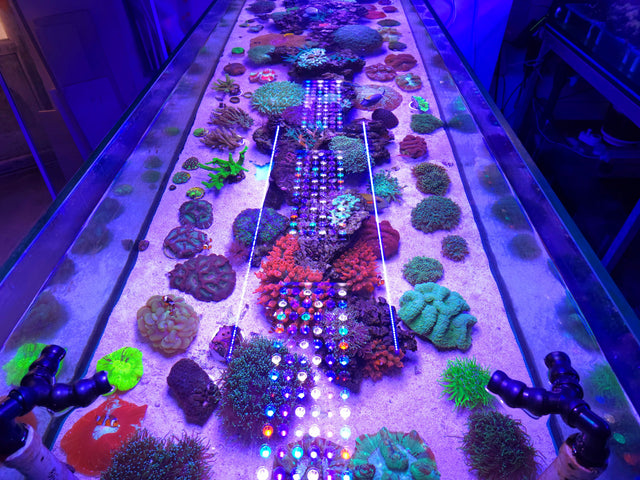
Product information "Beamswork LED HI-Lumen, for Aquarium"
LED luminaire containing blue and white LED for use on Aquarium and terrariums. High Lumen output due to efficient power LED chips.
The delivery includes power supply, LED Luminaire, and metal feet for installationNote:- Do not install under an Aquarium hood.- The lamp is only splash proof, so keep away from moisture
HI-Lumen50
16,5 W
42,0 x 12,5
30 x white+ 3 x blue
1515
45 - 60cm
Озонатор AquaLight ET 100
вариант
ЕТ100
Регулируем
10-100 мг/ч
максимална мощност
5 вата
Приложение
Сладководна/морска вода
2000/1000 л
препоръчителен въздушен поток
20-500 л/ч
регулируем
създава кристално чиста вода
намалява количеството на микробите
увеличава производителността на скимери, биофилтри и механични филтри
значително намалява замърсяването с нитрити и амоняк
увеличава редокс потенциала и съдържанието на кислород
отделя жълти вещества и други замърсители за разграждане
Приложение в сладка и морска вода
Skimz Macroalgae Biosorption Reactor (MBR) is a complete solution to leveraging the benefits of a concentrated algae scrubber, allowing users to grow algae within an upright contained reactor and place it in any sump. It is an excellent alternative for people who lack of space, but in need of a large algae scrubber. Growing algae like chaetomorpha will greatly help your reef aquarium with nutrient issues like nitrate and phosphate.
Skimz MBR157 includes a high power 360 degree LED that encased in a crystal clear quartz glass, allowing more light to pass through. The combination of Red, Blue and White LEDs provide an effective light source for algae grow and development.
The inclusion of DC pump give you full control of the flow rate through the algae. The highly efficient QuietPro DC pump with 9 different speed settings, allowing you to adjust the flow rate. As the water flow through the reactor and contacts the quartz sleeve, it will help to cool the LED lights.
Macroalgae Reactor Features:
• Small Footprint• LED Lighting System• DC Controllable Pump• Growing and Cultivating copepods• Biological Denitrification
Reactor Specifications:
• Footprint: 185 x 210mm (7 5/16" x 8 1/4")
• Total height: 570mm (22 7/16")
• Body diameter: 150mm (5 7/8")
Pump Specifications:
• Model: QuietPro QP2.0DC
• Power consumption: up to 22W
• Voltage: AC100-240 50-60Hz 24V DC/1.5A
• Pump controller: QPC35
LED Specifications:
- Model: RLD36
• Power consumption: 36W
• Voltage: AC100-240 50-60Hz 12V DC/5A
Total Power Consumption:
• up to 58W
For Aquarium:
• up to 1,000L
Installation:
• Designed for in-sump use
Lighting Duration:
12 hours is sufficient for growing macroalgae. The LED lighting is running on a reverse cycle so that when the main tank lights are off the LED lights turn on. During the night time, photosynthesis stops inside your aquarium and corals will no longer uptake CO2. This leaves an increased amount of CO2 dissolved in your aquarium water which then lowers your pH level. By running the Macroalgae Reactor at night, the algae inside the reactor will continue to uptake CO2 and help reduce the pH swing. This will help to stabilize the pH levels and the overall safety of its inhabitants.
Macroalgae Grows:
It's important to periodically harvest a portion by removing it from the Macroalgae Reactor. This opens up space for new macroalgae to grow and to continue absorbing undesirable nutrients
Skimz MBR127 Macroalgae Biosorption Reactor features the QuietPro 1.2 DC pump and has a small footprint that is great for hobbyists who have small sumps. MBR127 is suitable for aquariums up to 400 litres.
Dimensions: 175 x 176 x 410mm
Pump: QuietPro QP1.2 DC - 15W
LED: RLD18 - 18W
Total Watt: 33W
For Aquarium: up to 400L
Skimz Macroalgae Biosorption Reactor (MBR) utilizes microalgae as a method of nitrate and other unwanted nutrient export from your reef aquariums. Skimz MBR incorporates an LED Grow light tube using quartz glass to maximize light penetration and efficiency. Quartz glass consists of quartz crystals that results in a transparent glass with an ultra-high purity and improved optical transmission.
Skimz MBR is an excellent alternative for people who lack of space, but in need of a large algae filter. This small upright macroalgae reactor may still be the best option. Skimz MBR LED Grow light tube is specially build with combination of 2 Red: 1 Blue : 1 White to grow macroalgae. The LED light tube is water proof, uses very low power and the quartz glass has high working temperature.
Skimz MBR will allow you to grow beneficial macroalgae as well as house zooplanktons. Zooplanktons like copepods and amphipods would breed, and their babies would flow into the aquariums as a food source for corals and fish. These tiny microscopic crustaceans incorporate protein and fatty acids into a highly nutritious package for consumption by marine animals. Some fish, such as the mandarins, anthias and sea horses are found to be extremely difficult to get to eat anything other than copepods and amphipods.
The Yellow Belly Blue Tang, scientifically known as Paracanthurus hepatus, is a color variant of the popular Blue Tang, notable for its striking blue body and a yellow belly and tail. This variant also features a distinctive black marking on its upper body that forms a sort of "palette" design.
Key characteristics of the Yellow Belly Blue Tang:
Coloration: A vibrant blue body with a bright yellow tail and belly.
Markings: A black marking, shaped like a horizontal bar, extends from the back of the head, loops around the gills, and then extends back to the base of the tail.
Size: Can grow up to 8-12 inches (20-30 cm) in length.
Temperament: Generally peaceful but can become territorial and aggressive towards other tangs, especially when they mature.
Reef Compatibility: Reef safe, meaning they don't typically harm corals or other invertebrates.
Diet: Herbivorous, primarily consuming algae and marine plants.
Habitat: Found in coral reefs of the Indo-Pacific region.
Additional details:
The yellow coloration on the belly and tail is most prominent in adults, though even small juveniles may show some yellowing.
They are known for their active swimming and need a spacious aquarium with plenty of swimming room.
They are susceptible to certain diseases, particularly Ich, so maintaining good water quality and a healthy diet is crucial.
Their sharp tail spine (scalpel) is used for defense and can inflict a painful wound.
They require a varied diet, including algae-based foods, to maintain their health and reduce aggression.