Frozen cyclops is a small, fresh-frozen zooplankton food for fish and other aquatic animals, including fish larvae, small-mouthed fish, and marine invertebrates like corals. It is a nutritious, natural live-food alternative that can also promote vibrant colors in fish. The food is typically sold in convenient cubes or blister packs and is often gamma-irradiated to be pathogen-free.
What it is
Zooplankton: Made from tiny, fresh-frozen crustacean zooplankton.
Food for small mouths: An ideal food for fish larvae (fry), small-mouthed fish, seahorses, and pipefish.
Supports filter feeders: Excellent for marine filter-feeding invertebrates and corals.
Natural color enhancer: Contains natural pigments that can help promote vibrant colors in fish.
Pathogen-free: Often gamma-irradiated for safety.
How to use
Break off a small portion, such as a single cube.
Thaw it in a separate container with a small amount of tank water for about 20 minutes. Avoid using hot water or a microwave, as this can break down nutrients.
Slowly add the defrosted food to your aquarium.
Repeat a few times a week to help maintain health and color
"Krill Fine" is a frozen fish food consisting of finely chopped krill, ideal for smaller or more finicky fish like adult Discus, or for use as a base mix for larger species. It is a high-protein, nutrient-rich food that is a natural source of omega-3 fatty acids and astaxanthin, which enhances color. The fine size makes it easy to digest and encourages a feeding response in many fish.
Nutritional information
Protein: High in protein, typically around 50-55% dry matter.
Fat: Contains essential lipids, with up to 25% of the fat content consisting of omega-3 fatty acids.
Vitamins and minerals: A natural source of vitamins, carotenoids like astaxanthin (which enhances color), and other antioxidants.
Chitin: A good source of chitin, which can provide roughage.
Benefits
Enhances color:
The natural carotenoids, particularly astaxanthin, help intensify the red and other colors in fish.
Stimulates feeding:
The fine texture is a natural and appealing food source that can trigger an immediate feeding response.
Promotes health:
The high protein and essential fatty acids support overall health, energy levels, and proper growth.
Versatile:
Can be used as a staple food or as an additive for larger species in products like spod and stick mixes.
How to use
Store the frozen krill in a freezer and only thaw the amount you need for one feeding.
You can thaw it in a small amount of aquarium water before feeding, or in some cases, feed it while still frozen.
Only feed what your fish can consume within a few minutes to avoid soiling the aquarium.
Sextett Marin is a frozen food mix for marine aquariums containing six high-quality, natural ingredients like Artemia, Mysis, copepods, red plankton, fish meat, and fish eggs. It is enriched with vitamins, trace elements, and unsaturated fatty acids to promote the health and vitality of marine fish, corals, and invertebrates. This blend is typically sold in a blister pack for easy portioning and is ready to be defrosted and fed to your tank inhabitants.
Ingredients and composition
Artemia (Brine Shrimp): A staple, highly nutritious source of food.
Mysis: Small, shrimp-like crustaceans that are a great source of protein.
Copepods: Tiny planktonic crustaceans that are a natural part of a marine diet.
Red Plankton: A high-energy food source, often enriched with extra vitamins and fatty acids.
Fish Meat: Provides essential protein and other nutrients.
Fish Eggs (Roe): A nutritious and often highly palatable food for many marine creatures.
Nutritional benefits
Enriched with vitamins, trace elements, and Omega-3: Helps boost the vitality and health of fish and other aquarium life.
Promotes a strong immune system: The variety of nutrients helps build a healthy immune response in your inhabitants.
Natural and high-quality: Composed of 100% natural products that mimic a reef-like diet.
Mangrove trees are salt-tolerant plants that are grown in saltwater aquariums for their aesthetic appeal and natural nutrient control capabilities. They filter salt from the water through their roots and can help reduce nitrates, phosphates, and other organic waste. In the aquarium, they have visible roots and leaves that create a unique, natural-looking environment, but they require high light, proper water parameters, and can consume nutrients so heavily that you may need to supplement them.
The brackish aquarium - Algone
Brackish habitats can be found in nature throughout the world where river deltas meet the ocean. These environments are known as e...
Error! Filename not specified.
Algone
Red Mangrove Buy 2 Get 1 FREE | Saltwater Plants
This plant tolerates poor water quality and weak water movement. However, it ( red mangrove (Rhizophora mangle ) is adapted to liv...
Error! Filename not specified.
AlgaeBarn
Adaptations and functions
Salt filtration:
Mangroves have evolved to filter out about 90% of the salt as it enters their roots. Some species can also excrete salt through glands on their leaves.
Nutrient control:
They act as a natural filter for the aquarium, consuming nitrates, phosphates, and other organic waste. Larger mangroves are more effective at this.
Aesthetics:
Their unique stilt or prop roots, as seen in the popular Red Mangrove, create a beautiful and naturalistic look in the aquarium, especially in a reef tank or brackish setup.
Stress and care:
Mangroves are sensitive to nutrient fluctuations. If they consume too many nutrients, you may need to dose the tank with some nitrates and phosphates to prevent the corals from suffering. A lack of magnesium can also stress the plant.
Lighting:
They require high-output lighting, preferably in a warm white spectrum.
Any experience growing mangrove trees in aquariums? - Facebook
10.09.2022 г. — * Jeff Brinegar. You'll need very strong lighting. 3 yrs. * Jamie Lynn. So if you are looking for the cool roots of ...
Error! Filename not specified.
Facebook
Mangroves trees and shrubs
Silt roots: In some mangrove species, roots diverge from stems and branches and penetrate the soil some distance away from the mai...
Food and Agriculture Organization
Elevate Your Aquarium with Home-Grown Mangroves
Red mangroves have the ability to replace sodium ions, which are present in salt water, with magnesium ions. If you have a salt wa...
Error! Filename not specified.
TopTropicals.com
Mangroves in the Wild & Aquarium | Tropical Fish Hobbyist ...
Mangroves in the Wild and in the Home Aquarium. Author: Richard Aspinall. Salt-tolerant plants that are as unusual as they are bea...
Error! Filename not specified.
TFH Magazine
Aquarium setup and care
Lighting:
Provide moderate to high lighting, ideally with a PAR (Photosynthetically Active Radiation) value between 200 and 600.
Water parameters:
Keep the water temperature between 78–83°F and the salinity up to1.024
specific gravity (sg). The ideal pH is 7.0–8.4 and dKH 8–12.
Root placement:
For the most striking look, allow the roots to hang suspended in the water, rather than burying them.
Leaf care:
Regularly misting the leaves with freshwater can help avoid a buildup of salt on the leaf surfaces.
Substrate:
Plant the pods in a substrate like sand or a "miracle mud".
Nutrient balancing:
Monitor nutrient levels, especially nitrates and phosphates, as mangroves can "bottom out" the tank, which can stress other inhabitants. Be prepared
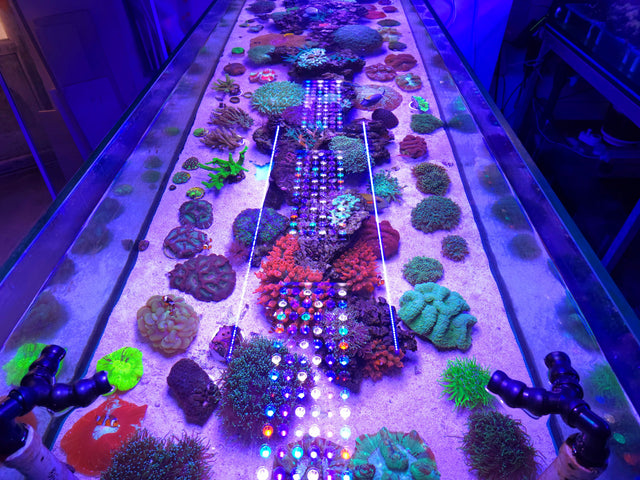
The Forest Fire Rhodactis mushroom is a soft coral known for its vibrant, fiery colors, typically a red or orange base with neon green, blue, or purple streaks and speckles that glow under aquarium lighting. It has a fleshy, textured appearance with wavy edges and is relatively easy to care for, thriving in low to moderate lighting and low water flow, making it a popular choice for beginner to experienced aquarists.
Appearance
Color: A bright base of red or orange with contrasting neon green, blue, or purple patterns that appear to glow.
Shape: Fleshy, with a bubble-like or wavy surface and textured edges.
Growth: Fast-growing and can spread to form a colorful carpet, filling negative space in an aquarium.
Care and maintenance
Lighting: Low to moderate lighting is ideal, around 30-50 PAR.
Water Flow: Low to moderate flow is preferred. Too much flow can stress the coral and cause it to detach from its rock.
Tank Placement: Can be placed in low to mid-level areas of the tank.
Care Level: Generally considered easy to care for.
Re-attachment: If the coral detaches, place it in a small cup with rubble to re-attach, or it may float around the tank.
Blastomussa merletti is a large polyp stony (LPS) coral known as a pineapple coral, characterized by its round, flower-like polyps and vibrant colors such as red, green, purple, and orange. It is a relatively easy to keep coral, suitable for beginners, that grows in clusters and is found in the Indo-Pacific region. This species thrives in low to moderate light with gentle water flow and can be supplemented with food.
Physical characteristics
Polyps:
Develop into small, round, flower-like structures that can resemble mushroom corals.
Color:
Often displays a mix of bright colors, commonly red with green oral discs or a combination of red, purple, and green. Other colors can include pink, orange, brown, or dark grey with white margins.
Mantle:
The mantle and tentacles are often visible and extended during the day.
Surface:
The surface can be continuous, sometimes obscuring the underlying growth form.
Blastomussa merleti
Corals of the World
Habitat and care
Habitat:
Native to the west and central Indo-Pacific region. It is also popular in reef aquariums.
Lighting:
Prefers low to moderate lighting, and can be overexposed in very bright conditions. High-end LED or T5 lighting is recommended.
Water Flow:
Needs a low to moderate flow. Excessive flow can be detrimental, so gentle, indirect water movement is best.
Tank placement:
Should be mounted on stable rock or sand, with some space around it, and kept away from aggressive neighbors.
Water chemistry:
Requires stable water parameters, including Calcium 400-450 ppm
Alkalinity 8-12dKH),
Magnesium 1250 -1350ppm),
and low levels of Nitrates 5-15 ppm
and Phosphates< 0.10ppm
Temperature:
Optimal temperature is between $76–80^\circ$F.
TSA Merlot Merletti Blastomussa Coral - Top Shelf Aquatics
Water Chemistry * Calcium: 400–450 ppm. * Alkalinity: 8–12 dKH. * Magnesium: 1250–1350 ppm. * Nitrates: 5–15 ppm. * Phosphates: <
Error! Filename not specified.
Top Shelf Aquatics
Feeding and growth
Supplementation: Can be supplemented with LPS pellets or other small particle foods to promote growth and color, though it is not strictly necessary as it is photosynthetic.
Growth: Grows in tight clusters and can spread over rockwork to create colorful spots in a reef tank.
Temperament: Considered a peaceful coral.
Stenorhynchus seticornis, or the yellowline arrow crab, is a crustacean with a triangular body, a long, pointed rostrum (snout), and long, spindly legs. Its color is variable, often golden-brown or yellow, with lines on the carapace and reddish or yellow legs. The claws are frequently blue or violet-tipped.
Physical characteristics
Body: Triangular shape, resembling an arrowhead.
Rostrum: An extremely elongated, pointed snout, often with serrated edges.
Legs: Long and thin, sometimes spanning up to 10 cm (3.9 in).
Claws: The first pair of legs are transformed into claws, which are often blue or violet at the tips.
Size: Carapace length is typically 3 to 6 cm (1.2 to 2.4 in).
Coloration
Body: Can be golden, yellow, or cream.
Markings: Often features fine dark, brown, or iridescent blue lines on the carapace.
Legs: Can be reddish or yellow.
Habitat and behavior
Habitat: Found in the western Atlantic, from North Carolina to Brazil, and is common on coral reefs in the Caribbean.
Behavior: It is a nocturnal scavenger that feeds on small invertebrates, detritus, and parasites off of fish.
Association: Often lives in groups near sea anemones.
Plexaurella nutans is a gorgonian sea rod commonly called the Giant slit-pore sea rod, which grows to over 1 meter tall with thick, branching, and often club-ended branches. It is characterized by a brownish-tan to lavender color and has unique slit-shaped apertures where the polyps emerge, creating a "fuzzy" or "dimpled" surface when extended. This photosynthetic, zooxanthellate coral is found in the Caribbean and South Florida, and it feeds on plankton.
Appearance
Height: Colonies can grow to over 1 meter tall.
Colony form: Moderately branched, bushy, or tall with sparse branching.
Branches: Thick, cylindrical, and moderately robust, with diameters of 7-18 mm. They often have club-shaped or bulbous tips.
Apertures: Distinctly slit-shaped, often raised on small mounds, giving the surface a dimpled or fuzzy appearance.
Color: Ranges from tan, yellowish-brown, or light brown to gray or sometimes mauve.
Biology and Ecology
Habitat:
Found on patch reefs, outer slopes, and fore reefs in depths from 3 to 49 meters.
Diet:
A mixotrophic species; it feeds on zooplankton using its polyps and also contains symbiotic photosynthetic algae (zooxanthellae) in its tissues.
Axis:
The internal axis is heavily mineralized with calcite.
Location:
Found in the waters of South Florida, Bermuda, and throughout the Caribbean Sea.
Chrysiptera talboti, or Talbot's Demoiselle, is a small fish (up to 6 cm) characterized by a bright yellow head and pelvic fins, a purplish-grey body, and a prominent black spot on its dorsal fin. It has a distinctive black anal papilla, a pinkish tinge to its body, and is often found solitary in reef depressions.
Appearance
Body: Purplish-grey or pearly grey with a pinkish tinge.
Head and pelvic fins: Bright yellow.
Dorsal fin: A large black spot is located at the base of the spinous part of the dorsal fin, usually over the last four spines.
Anal fin: A black anal papilla is present.
Size: Reaches a maximum length of about 6 cm (2.4 inches).
Behavior and habitat
Habitat: Inhabits coral-rich areas, such as seaward reef slopes and deep lagoons.
Social behavior: Usually solitary, but can be found in groups in its natural habitat. In an aquarium, they are known to be territorial, especially as they mature, and may become aggressive toward other damselfish.
Activity: Active and diurnal (active during the day).
Temperament: Can range from peaceful to moderately aggressive, depending on age and environment.
Other characteristics
Diet: Feeds on zooplankton and planktonic crustaceans in its natural habitat. In captivity, they will accept flakes, pellets, and meaty foods.
Reproduction: Oviparous (egg-laying) and protandric hermaphrodites, meaning they are born male and change to female as they age
The Orangeback fairy-wrasse (Cirrhilabrus aurantidorsalis) is a small, colorful fish known for its vibrant orange back, which contrasts with a magenta stripe along its body and a shimmering belly. Males are more intensely colored, especially during courtship, and have a dark red "crown" marking. They inhabit coral reefs in the Indo-Pacific, live in small groups with one male and several females, and are popular in the aquarium trade for their peaceful nature and activity level.
Appearance
Coloration:
Has a brilliant orange or golden-orange back, a magenta stripe running the length of the body, and a belly that can be pink, blue, or purple.
Male features:
Males have more intense colors and a dark red crown-like marking on the head. During courtship, their colors intensify significantly.
Female features:
Females are less vibrant, with a reddish-brown body, white face, and white belly.
Body shape:
Slender and elongated body.
Habitat and behavior
Habitat:
Found in the Indo-Pacific, specifically in the eastern Tomini Bay and Lembeh Strait, on reef slopes and edges with rubble areas.
Social structure:
Lives in small groups (harems) consisting of one male and several females. All are believed to start as females, with some transforming into males.
Temperament:
Peaceful and active fish, making them suitable for reef aquariums. They are reef-safe and will not harm corals or invertebrates.
Jumping:
Known to be good jumpers, so a tight-fitting lid on the aquarium is essential.
Diet
Primary food: Zooplankton.
Aquarium diet: Readily accepts a variety of meaty foods, such as frozen mysis shrimp, brine shrimp, and other high-quality flakes, pellets, and frozen/live foods.
The Acanthurus japonicus, or Powder Brown Tang, is an Indo-West Pacific surgeonfish with a laterally compressed, oval body that can reach up to 21 cm in length. Its coloration varies based on its mood, from brown to blue to yellow, but it is distinguished by a prominent white band between the mouth and eye, a bright orange stripe on the dorsal fin, and a yellow band on the caudal peduncle. It is a herbivorous, territorial fish that typically lives in small to large aggregations in reef environments.
Physical description
Body shape: Oval and laterally compressed.
Size: Can grow up to 21 cm (8.3 in) in length.
Coloration:
The body color can range from brown to blue to yellow, depending on the fish's emotional state.
A wide, white band runs from the lower part of the eye to the upper lip.
A bright orange or pink band is present along the soft-rayed part of the dorsal fin.
The caudal peduncle is black with a yellow base.
Fins:
Dorsal fin: Has 9 spines and 28–31 soft rays.
Anal fin: Has 3 spines and 26–29 soft rays.
Caudal fin: Is truncate.
Pectoral fins: Have yellow bases.
Habitat and behavior
Habitat: Lives in clear lagoon and seaward reefs in the Indo-West Pacific, typically in shallow, exposed areas.
Diet: Herbivorous, feeding on algae and seaweed.
Social behavior: Can be found alone or in small to large aggregations. They are territorial and can be aggressive towards other fish, especially other tangs or conspecifics, which can lead to fights.
The ATI Essentials Mixed Reef set 2x2.7 L is a two-part, ultra-concentrated liquid supplement for mixed reef aquariums that supplies major and trace elements to promote coral growth, coloration, and health. It simplifies aquarium maintenance by providing a ready-to-use, highly concentrated solution that doesn't require mixing, with a simple equal dosage for both parts. The formula includes elements like calcium, magnesium, and alkalinity, as well as essential trace elements, and is optimized to help reduce nitrates and phosphates in tanks with higher fish loads.
Key features
Two-part liquid system:
The set includes two 2.7 L bottles containing essential major and trace elements for your aquarium.
Highly concentrated:
The formula is approximately 5 times more concentrated than traditional Balling solutions, making the 5.4 L set space-saving.
Ready to use:
No mixing or preparation is required, saving time and effort.
Simple dosing:
Both parts of the solution are dosed in equal amounts, which can be adjusted based on the aquarium's specific needs for alkalinity and calcium consumption.
Comprehensive elements:
It provides a complete supply of major elements like calcium, magnesium, and alkalinity, plus trace elements like iodine, iron, and zinc, without causing unwanted accumulation.
Nutrient reduction:
The included "KH Complex" contains organic KH sources that help reduce nitrates and phosphates, making it ideal for mixed reefs with higher fish stocking.
Stabilizes parameters:
Helps stabilize water chemistry, which promotes better coral growth, metabolism, and coloration.
Low-temperature crystallization:
At low temperatures, crystals may form in the bottle. You can dissolve them by warming the bottle in a warm water bath. If operating at cold temperatures, it's recommended to dilute both solutions 1:1 with RO water.