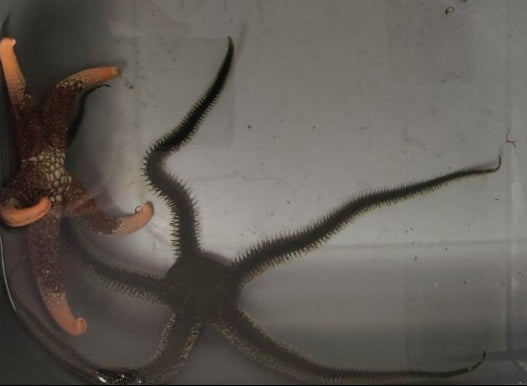
Ophiarachna incrassata M/L

Description

  • Ophiarachna incrassata, widely known as the Green Brittle Star or Thick-armed Brittle Star, is a large, predatory marine echinoderm native to the Indo-West Pacific. Highly active and robust, it is famous among aquarists for its striking appearance and surprising predatory behavior. 

Physical Characteristics

  • Size: It is one of the largest brittle stars, with a central disc (body) that can measure up to \(5\) cm (\(2\) inches) in diameter. Its five arms can grow up to \(20\) to \(25\) cm (\(8\) to \(10\) inches) long, giving the entire creature a striking span of up to \(50\) cm (\(20\) inches). 

  • Coloration: Its base color ranges from muted or bright green to brownish-green. The central disc is typically adorned with lighter yellowish dots or markings, and the arms are often lined with alternating whitish to yellowish-white spines. 

Habitat and Range

  • Natural Range: Widespread throughout the tropical Indo-West Pacific, spanning from the Red Sea to Hawaii and the coasts of northern Australia and Japan. 

  • Environment: Found in shallow, tropical littoral waters, usually at depths of less than \(10\) meters (\(30\) feet). They are benthic dwellers, commonly found on reef flats tucked among coral rubble, rocks, seagrass beds, and algae.

Diet and Behavior

  • Feeding Habits: Unlike many brittle stars that strictly scavenge, Ophiarachna incrassata is a highly capable predator. While they will eat detritus, zooplankton, and meaty leftovers, they also actively hunt and capture small fish and other invertebrates using their thick, flexible arms. 

  • Movement: They use their arms to crawl rapidly across the seafloor, making them surprisingly fast for echinoderms. 

  • Temperament: They are solitary and generally secretive, often hiding in rock crevices during the day. They are known to be somewhat aggressive toward other tank inhabitants and should be kept with caution in reef aquariums containing small, sleeping fish

Product form

Ophiarachna incrassata, widely known as the Green Brittle Star or Thick-armed Brittle Star, is a large, predatory marine echinoderm native... Read more

1 in stock

€50,00 Incl. VAT

      Description

      • Ophiarachna incrassata, widely known as the Green Brittle Star or Thick-armed Brittle Star, is a large, predatory marine echinoderm native to the Indo-West Pacific. Highly active and robust, it is famous among aquarists for its striking appearance and surprising predatory behavior. 

      Physical Characteristics

      • Size: It is one of the largest brittle stars, with a central disc (body) that can measure up to \(5\) cm (\(2\) inches) in diameter. Its five arms can grow up to \(20\) to \(25\) cm (\(8\) to \(10\) inches) long, giving the entire creature a striking span of up to \(50\) cm (\(20\) inches). 

      • Coloration: Its base color ranges from muted or bright green to brownish-green. The central disc is typically adorned with lighter yellowish dots or markings, and the arms are often lined with alternating whitish to yellowish-white spines. 

      Habitat and Range

      • Natural Range: Widespread throughout the tropical Indo-West Pacific, spanning from the Red Sea to Hawaii and the coasts of northern Australia and Japan. 

      • Environment: Found in shallow, tropical littoral waters, usually at depths of less than \(10\) meters (\(30\) feet). They are benthic dwellers, commonly found on reef flats tucked among coral rubble, rocks, seagrass beds, and algae.

      Diet and Behavior

      • Feeding Habits: Unlike many brittle stars that strictly scavenge, Ophiarachna incrassata is a highly capable predator. While they will eat detritus, zooplankton, and meaty leftovers, they also actively hunt and capture small fish and other invertebrates using their thick, flexible arms. 

      • Movement: They use their arms to crawl rapidly across the seafloor, making them surprisingly fast for echinoderms. 

      • Temperament: They are solitary and generally secretive, often hiding in rock crevices during the day. They are known to be somewhat aggressive toward other tank inhabitants and should be kept with caution in reef aquariums containing small, sleeping fish

      Recently viewed products

      © 2026 Aquariumprime Ltd., Powered by Shopify

        Login

        Forgot your password?

        Don't have an account yet?
        Create account