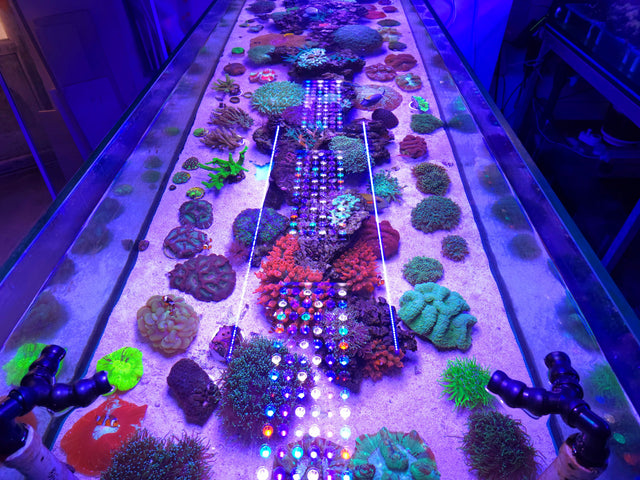
The Turbo fluctuosa, commonly called the Mexican Turbo Snail or Super Turbo Snail, is a marine gastropod mollusk known for its unique, top-shaped shell and its effectiveness at consuming algae. These snails are popular in reef aquariums due to their ability to quickly remove nuisance algae, including hair algae, from live rock and aquarium glass.
Key characteristics:
Shell: The Turbo fluctuosa has a thick, top-shaped shell with an iridescent interior. The shell can be olivaceous, green, brown, or grayish, with white longitudinal stripes or spots.
Diet: It's a herbivore that feeds primarily on algae, including hair algae, cyanobacteria, and diatoms. It is also known to consume Asparagopsis algae, which can be problematic in reef aquariums.
Behavior: These snails are active both day and night and move slowly over surfaces, grazing on algae. They can bulldoze loose rocks in search of food, so aquariums with well-secured rockwork are recommended.
Aquarium Care: Turbo fluctuosa snails thrive in well-established tanks with plenty of live rock and are compatible with most reef aquarium inhabitants. Adequate calcium levels are needed for shell growth, and supplemental feedings with dried seaweed may be necessary if algae levels are low.
Origin: They are native to the Gulf of California, off the coast of Mexico.
Size: They can grow up to 2 inches in diameter
Tridacna maxima is a popular, highly sought-after, and challenging (intermediate-level) reef aquarium clam known for its intense, varied mantle colors (blue, green, gold, purple) and intricate patterns. They require high-intensity lighting, stable water parameters (calcium 400-440 ppm), and a rocky substrate for attachment. Maximas are smaller, growing up to 12-16 inches, and prefer to be placed high in the tank with moderate to high water flow.
Key Characteristics & Requirements:
Appearance: Features highly variable, vibrant mantles with spots, stripes, or mottled patterns. Their shells are less symmetrical than other clams, with small scutes.
Size: Generally grows to around 12 inches (30 cm) in aquariums, though some may grow slightly larger.
Lighting: Requires intense lighting (Metal Halide or high-output LED).
Placement: Must be placed on a hard, rocky surface where they will attach using byssal threads.
Flow: Prefers moderate to high, chaotic water movement rather than simple, laminar flow.
Diet: Primarily photosynthetic (symbiotic algae), but smaller specimens (inches) benefit from frequent phytoplankton feedings.
Placement Strategy: Ideal for placing in rocky, high-light areas of the reef scape.
Aquarium Compatibility & Care:
Difficulty: Intermediate.
Temperament: Peaceful.
Reef Safe: Yes.
Tank Size: 75-100+ gallons.
Acclimation: Requires slow acclimation to lighting to avoid bleaching.
Potential Hazards: Beware of parasites like pyramidellid snails and fish that may pick at the mantle (e.g., angelfish, wrasses).
Nardoa novaecaledoniae, also known as the Goldtip Starfish, Yellow Mesh Sea Star, or Peach Tip Mesh Sea Star, is a species of sea star in the family Ophidiasteridae. These starfish are found in the Indo-Pacific region, including areas like Australia, Indonesia, and the Philippines.
Key features of Nardoa novaecaledoniae:
Appearance: They are characterized by their vibrant coloration, often with a tan to brown body and golden or peach-colored tips on their arms. The arms can also have white spots on the central disc that get smaller as they move towards the arm tips.
Size: Nardoa novaecaledoniae can grow up to 10 inches (25 cm) in diameter.
Habitat: They typically inhabit shallow, rocky reefs.
Diet: They are omnivores, feeding on algae, small fish, and mussel flesh.
Care: They are not commonly seen in the home aquarium trade and can be sensitive to sudden changes in salinity.
Range: They are found in the Western Pacific Ocean.
The Ciliopagurus strigatus, commonly known as the Halloween hermit crab, is a brightly colored hermit crab with a vibrant orange and black striped appearance. They are popular in marine aquariums due to their distinctive colors and usefulness as algae eaters and scavengers.
Key features and characteristics:
Appearance:
The Halloween hermit crab is easily recognizable by its bright orange and red striped "stockings". They also have a small claw on the left side.
Habitat:
They are found in the Central Pacific region, and are often associated with reef environments.
Diet:
They are omnivores, feeding on algae, detritus, leftover food, and sometimes other small creatures.
Behavior:
They are scavengers, sifting through the substrate to clean up detritus and algae. They also help aerate the substrate by moving the sand.
Reef-safe:
Generally considered reef-safe, they do not pose a threat to reef corals or other reef inhabitants.
Shells:
They live in borrowed shells, usually abandoned snail shells, and may even attack and consume snails to obtain a shell.
Maintenance:
In aquariums, they should be provided with a variety of shells to choose from, and their diet may need to be supplemented with algae and other food items if necessary.
In short, the Halloween hermit crab is a visually appealing and useful addition to a marine aquarium, known for its vibrant colors, algae-eating habits, and cleaning skills
Bubble-tip anemones, scientifically named Entacmaea quadricolor, are sea anemones known for their distinctive, bulbous tentacle tips. These anemones display a range of colors, including greens, tans, browns, and maroons. They have a sticky foot called a "basal disc" that they use to attach to surfaces, and their bodies consist of a cylindrical stalk topped with an oral disc surrounded by tentacles.
Key features of Bubble-tip Anemones:
Bulbous Tentacles:
The most prominent feature is the bubble-like or pear-shaped tips on their tentacles, which give them their common name.
Color Variation:
They can be found in various colors, including green, tan, brown, and maroon.
Sticky Foot:
They have a basal disc (or pedal disk) that helps them anchor to surfaces.
Symbiotic Relationship:
Bubble-tip anemones can host clownfish and other anemonefish, forming a beneficial symbiotic relationship.
Growth:
They can grow up to a foot in diameter, but typically remain smaller in aquariums.
Location:
They are found in oceans around the world, including the Indo-Pacific area and the Red Sea.
In essence, the Bubble-tip Anemone is a vibrant, adaptable creature with unique characteristics, making it a popular choice for marine aquariums
Anthelia coral, also known as Waving Hand or Glove Coral, is a soft coral genus characterized by long, thin, and often purple or bluish polyps that wave gracefully in the current. These corals form a creeping mat, with their polyps extending from the base. They are known for their light appearance and constant movement, resembling an underwater field of seagrass.
Here's a more detailed description:
Appearance: Anthelia corals have a distinctive appearance with long, thin polyps that resemble gloves or waving hands. They often have a creeping mat base, with the polyps extending upwards.
Color: They can come in various colors, including pink, blue, brown, or tan.
Movement: The polyps of Anthelia corals wave in the water current, giving them their common name "Waving Hand Coral". They are not known for the pulsing behavior seen in Xenia corals, but rather a gentle swaying.
Growth: Anthelia corals are fast-growing and can quickly cover adjacent rock work.
Care: They are relatively easy to care for, requiring medium to high lighting and a medium to strong water flow.
Invasive: They can be a bit invasive and should be placed with plenty of space, as they may overgrow other corals.
Other names: They are also referred to as "Glove Coral," "Pom-Pom Coral," or "Anthelia Waving Hand Coral".
Nutrient requirements: While they rely on symbiotic zooxanthellae for photosynthesis, trace elements like iodine are beneficial.
Anthelia corals are a popular addition to reef aquariums, adding a visually appealing and dynamic element with their waving polyps and graceful movement
Pulsing Xenia (Heteroxenia fuscescens) is a soft coral known for its rhythmic, pulsing movement and feathery polyps. It has long, sturdy stalks adorned with feathery tentacles that pulse, opening and closing in a "pumping" fashion, adding movement to the reef tank. Pulsing Xenia is a fast grower and a popular choice for reef tanks, both for beginners and experienced hobbyists.
Here's a more detailed description:
Appearance:
Stalks:
Pulsing Xenia features long, sturdy stalks.
Polyps:
The stalks are topped with feathery polyps (tentacles) that pulse in a rhythmic, opening and closing motion.
Colors:
Pulsing Xenia can come in a variety of colors, including lavender, cream, pink, and purple.
Growth:
It's known for its rapid growth rate, which can quickly cover rock surfaces.
Movement:
Pulsing:
The most distinctive feature of Pulsing Xenia is its rhythmic pulsing movement of the polyps, which can reach up to 40 pulses per minute.
Water Movement:
The pulsing action helps to create water movement around the coral, aiding in nutrient exchange.
Other Notable Features:
Fast Growth:
Pulsing Xenia is a fast-growing coral, making it a good choice for beginners who are looking for a coral that will quickly fill up the tank.
Easy Care:
It's relatively easy to care for, thriving in a variety of reef tank conditions.
Photosynthesis:
Pulsing Xenia is a photosynthetic coral, meaning it can produce its own food through sunlight, but it also absorbs nutrients from the water.
Propogation:
It can be easily propagated in captivity
price per polyp
Rhodactis, commonly known as mushroom corals, are a type of corallimorph that are easily recognizable by their large, individual polyps that resemble mushrooms. They are related to stony corals but do not form a stony skeleton. Rhodactis are popular in reef aquariums for their easy care and adaptable nature.
Key Characteristics of Rhodactis:
Appearance:
They are soft, fleshy, and have a jelly-like texture. Their individual polyps can be quite large, often reaching 1-18 inches in size.
Color and Texture:
They come in a wide variety of colors, including green, brown, tan, pink, and purple, and can have different textures, some even resembling hairy mushrooms.
Habitat:
They are found in the Indo-Pacific region, including Fiji, Tonga, Solomon Islands, and the Great Barrier Reef.
Care:
Rhodactis are known for being easy to care for and can thrive in a variety of aquarium environments.
Feeding:
They are photosynthetic and can also feed on particulate matter and small invertebrates.
Lighting:
Rhodactis generally prefer low to moderate lighting, ideally in the range of 75-150 PAR.
Flow:
They prefer low to moderate water flow.
Rhodactis in Reef Aquariums:
Rhodactis mushrooms are a popular choice for both beginner and experienced aquarists.
They can be placed in a variety of reef tank environments, making them a versatile choice.
They can be propagated (fragged) by experienced hobbyists.
Some species, like the Elephant Ear variety, can even be aggressive feeders and may consume smaller fish.
Gorgonia, or sea fans, are a genus of soft corals found in marine environments, particularly in areas with strong water currents. They are characterized by their fan-like shape and often have a purple hue, though other colors like brown or yellow can also occur. Sea fans are colonial invertebrates, meaning they are made up of many individual polyps, which are small, fragile, white "flower-like" structures.
Key Features:
Colonial Nature:
Gorgonians are colonies of polyps, which are attached to a central axis composed of gorgonin and calcite.
Fan-like Structure:
The polyps are arranged in a fan-like pattern, creating the distinctive shape of sea fans.
Color Variation:
While often purple, sea fans can also be brown, yellow, or even pink, depending on environmental factors and the presence of pigments in their spicules (needle-like parts of calcium carbonate).
Filter Feeders:
Sea fans are filter feeders, meaning they capture small particles of food from the water current using their tentacles.
Geographic Distribution:
Common sea fans (Gorgonia ventalina) are found in the Caribbean Sea and tropical western Atlantic, including areas like the Florida Keys, Cuba, Belize, and Venezuela
Briareum is a genus of soft corals in the family Briareidae.The coral is cultivated by aquarium owners (under the common name "green star polyp" or GSP) for its fluorescing polyps, which reveal themselves under actinic light. The genus is in need of extensive examination, as many specimens sold by marketers display unique and similar characteristics, but are often labeled as one species, Pachyclavularia violacea.
Price per branching frag
Cladiella are a genus of soft coral belonging to the family Alcyoniidae. They are known for their distinctive finger-like projections, which can be round or cone-shaped, extending from a short stalk. These projections branch in various directions and have polyps extending from their tips. Cladiella are hardy, fast-growing corals that can grow up to 41 cm in height. They are often pale in color, with contrasting brown or greenish-brown polyps. They are also known to be slimy to the touch due to the production of mucus.
Here's a more detailed description:
Appearance:
Cladiella have a leathery, smooth base tissue, which can be pale or white, often with an orangey-pink central column. The finger-like projections are the most noticeable feature, with polyps extending from their tips.
Color:
The base tissue is typically pale or white, while the polyps can be brown or greenish due to the presence of zooxanthellae (symbiotic algae). Some species, like Cladiella australis, are known to appear brown with extended polyps but turn white when the polyps retract.
Growth:
Cladiella are relatively fast-growing corals, with some species reaching up to 41 cm in height.
Habitat:
Cladiella are commonly found in the Indo-Pacific region.
Care:
Cladiella are relatively easy to keep in a reef aquarium and are often recommended for beginners. They prefer a moderate to strong current and are adaptable to varying water parameters.
Other notable features:
They are known for their hardiness and can be found in a variety of colors, including pink, red, and purple.
Lobophytum is a genus of soft corals, also known as devil's hand or finger leather corals, found in the Indo-Pacific region. These corals are characterized by their fleshy, finger-like outgrowths forming an umbrella-like structure on a short stalk. They are often tan or purple, but can also be brightly colored.
Key features of Lobophytum corals:
Appearance:
They resemble Sarcophyton (toadstool leathers) but have thick-fleshed, finger-like outgrowths.
Distribution:
Found in shallow water throughout the tropical Indo-Pacific.
Identification:
Accurate species identification requires microscopic examination of sclerites (calcareous needles).
Care:
Lobophytum corals require moderate to high lighting to support zooxanthellae, filter-feed, and may benefit from plankton supplements.
Aggression:
They are moderately aggressive, potentially releasing a toxin that irritates other corals.
Propagation:
Lobophytum corals are known for easy propagation and "fragging".
Microbiome:
Research suggests that the soft coral microbiome is relatively resilient to short-term environmental stressors.
Lighting:
Lobophytum corals are not particularly picky about lighting, but low to moderate light is generally preferred.
Salinity:
Maintaining a salinity between 34/35 per mille (1.022 and 1.024 density) is crucial for their health.